Skip to content

Microsoft Azure IoT Developer

Here you have the best Microsoft AZ-220 practice exam questions

  • Preview the first 5 of 251 questions for free
  • These questions were last updated on June 6, 2026
  • This site is not affiliated with or endorsed by Microsoft.
Question 1 of 251

Note: This question is part of a series of questions that present the same scenario. Each question in the series contains a unique solution that might meet the stated goals. Some question sets might have more than one correct solution, while others might not have a correct solution.

After you answer a question in this section, you will NOT be able to return to it. As a result, these questions will not appear in the review screen.

You have an Azure IoT solution that includes an Azure IoT hub, a Device Provisioning Service instance, and 1,000 connected IoT devices.

All the IoT devices are provisioned automatically by using one enrollment group.

You need to temporarily disable the IoT devices from the connecting to the IoT hub.

Solution: From the Device Provisioning Service, you disable the enrollment group, and you disable device entries in the identity registry of the IoT hub to which the IoT devices are provisioned.

Does the solution meet the goal?

Answer

Suggested Answer

The suggested answer is A.

To temporarily disable the IoT devices from connecting to the IoT hub, you need to perform two primary actions: first, disable the enrollment group in the Device Provisioning Service (DPS) to stop future auto-provisioning of devices, and second, disable the device entries in the identity registry of the IoT hub to prevent existing devices from communicating with the hub. This approach ensures that the devices are temporarily prevented from both auto-provisioning and current communication, effectively meeting the goal.

Question 2 of 251

Note: This question is part of a series of questions that present the same scenario. Each question in the series contains a unique solution that might meet the stated goals. Some question sets might have more than one correct solution, while others might not have a correct solution.

After you answer a question in this section, you will NOT be able to return to it. As a result, these questions will not appear in the review screen.

You have an Azure IoT solution that includes an Azure IoT hub, a Device Provisioning Service instance, and 1,000 connected IoT devices.

All the IoT devices are provisioned automatically by using one enrollment group.

You need to temporarily disable the IoT devices from the connecting to the IoT hub.

Solution: You delete the enrollment group from the Device Provisioning Service.

Does the solution meet the goal?

Answer

Suggested Answer

The suggested answer is B.

Deleting the enrollment group from the Device Provisioning Service will prevent new devices from being provisioned. However, it does not affect devices that are already provisioned and connected. To temporarily disable the IoT devices from connecting to the IoT hub, you must disable the enrollment group and disable the device entries in the identity registry of the IoT hub to which the devices are already provisioned.

Question 3 of 251

Note: This question is part of a series of questions that present the same scenario. Each question in the series contains a unique solution that might meet the stated goals. Some question sets might have more than one correct solution, while others might not have a correct solution.

After you answer a question in this section, you will NOT be able to return to it. As a result, these questions will not appear in the review screen.

You have an Azure IoT solution that includes an Azure IoT hub, a Device Provisioning Service instance, and 1,000 connected IoT devices.

All the IoT devices are provisioned automatically by using one enrollment group.

You need to temporarily disable the IoT devices from the connecting to the IoT hub.

Solution: From the IoT hub, you change the credentials for the shared access policy of the IoT devices.

Does the solution meet the goal?

Answer

Suggested Answer

The suggested answer is B.

Changing the credentials for the shared access policy of the IoT devices will indeed prevent the devices from connecting to the IoT hub. However, this method is not the most efficient nor temporary, as it requires you to manage and restore the credentials later. A more appropriate solution would be to disable the devices directly from the IoT hub or to temporarily disable the enrollment group, which would effectively and temporarily prevent the devices from connecting.

Question 4 of 251

HOTSPOT -

You have an Azure IoT hub.

You plan to deploy 1,000 IoT devices by using automatic device management.

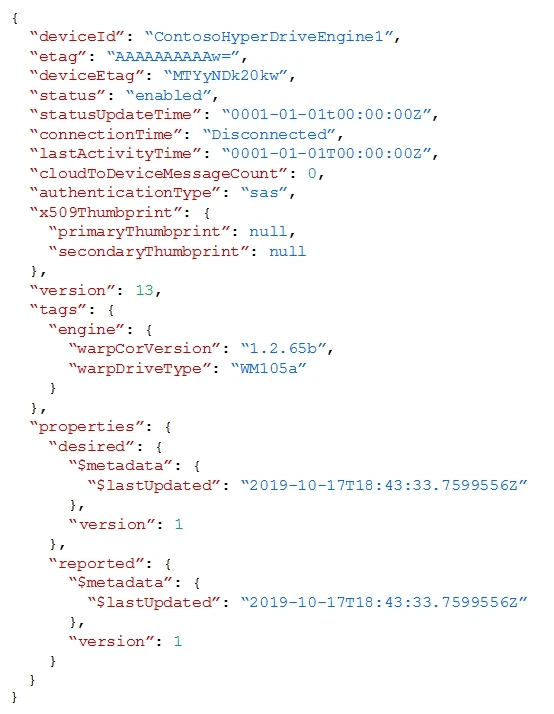
The device twin is shown below.

Exam AZ-220: Question 4 - Image 1

You need to configure automatic device management for the deployment.

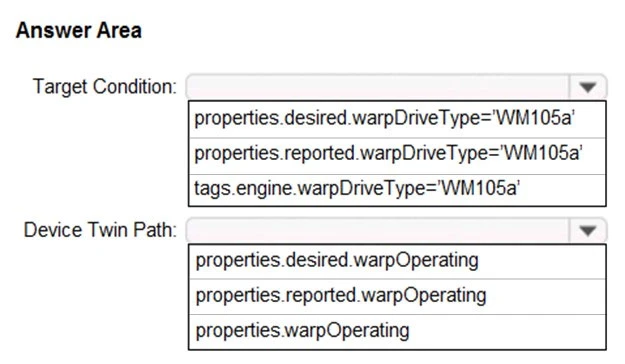
Which target Condition and Device Twin Path should you use? To answer, select the appropriate options in the answer area.

NOTE: Each correct selection is worth one point.

Hot Area:

Exam AZ-220: Question 4 - Image 2
Answer

Suggested Answer

Box 1: tags.engine.warpDriveType='VM105a'
Use tags to target twins. Before you create a configuration, you must specify which devices or modules you want to affect. Azure IoT Hub identifies devices and using tags in the device twin, and identifies modules using tags in the module twin.
Box 2: properties.desired.warpOperating
The twin path, which is the path to the JSON section within the twin desired properties that will be set.
For example, you could set the twin path to properties.desired.chiller-water and then provide the following JSON content:
{
"temperature": 66,
"pressure": 28
}
Reference:
https://docs.microsoft.com/en-us/azure/iot-hub/iot-hub-automatic-device-management Exam AZ-220: Question 4 - Image 3
Question 5 of 251

You plan to deploy a standard tier Azure IoT hub.

You need to perform an over-the-air (OTA) update on devices that will connect to the IoT hub by using scheduled jobs.

What should you use?

Answer

Suggested Answer

The suggested answer is D.

To perform an over-the-air (OTA) update on devices connected to an Azure IoT hub using scheduled jobs, you should use a direct method. Direct methods are suitable for triggering specific actions on IoT devices in real-time, such as initiating a firmware update. This option allows the job to invoke the necessary update process on the devices, which aligns with the requirement of performing scheduled OTA updates. While other methods like cloud-to-device messages and device twin properties have their use cases, direct methods are specifically designed for executing precise actions like firmware updates on devices.

Community Votes10 votes
CMost voted
70%
DSuggested
30%

246 more questions await

Unlock the full Microsoft AZ-220 question bank

5 of 251 completed2%

Choose your plan

Single payment · No subscription · No hidden fees

Standard

Quick preparation

$25

30 days access

30 day access to all questions
Instant free updates
Highest passing rate in industry
Printable PDF download
No money back guarantee
Best Value

Premium

Guaranteed success

$60$35

90 days access

PDF

Printable PDF download

New

Save every question as a PDF for offline study or printing.

90 day access to all questions
Instant free updates
Highest passing rate in industry
Pass guaranteed or money back

100% Money Back Guarantee

Don't pass? Full refund.

4.9/5

Based on 6,428+ reviews

Trusted by thousands of professionals

Join certified professionals who passed their exams with Examice

Examice helped me pass my AWS certification on the first try! The questions were incredibly similar to the real exam. Comments helped me understand answers I was struggling with.
S
Sarah C.
Cloud Engineer
Great results in a short prep time. Passed on my first attempt.
D
David K.
Network Engineer
I needed to pass an exam for work, and this website delivered. The quality for the price is outstanding, and the support is really good. I passed without issues.
M
Michael R.
Security Analyst
Skeptical at first, but impressed. Every question included clear, detailed explanations.
L
Lisa M.
Solutions Architect
The guarantee gave me confidence to invest in the premium package. Turns out I didn't need it. Passed comfortably. The explanations for each answer were incredibly detailed and helped me grasp security concepts that I'd been struggling with for months.
R
Robert H.
Cybersecurity Consultant
Used Examice for my PMP certification. The questions were well structured and covered all exam domains thoroughly.
J
James T.
IT Manager
After failing my first attempt with other study materials, I switched to Examice and passed confidently on my second attempt.
A
Anna W.
Data Engineer
The premium package was worth it. 90 days of access gave me the flexibility to study when it worked for me, without feeling rushed.
E
Emily J.
DevOps Engineer
Straightforward questions that matched the real exam perfectly. Studied for two weeks and passed with a great score.
K
Karen P.
Systems Administrator

Frequently Asked Questions

Everything you need to know. Contact us for more.

Our Microsoft AZ-220 questions are based on real exam experiences and are continuously updated to match the current exam format. Most candidates who study with us report passing on their first attempt, based on a self reported post exam survey.

With our Premium package, you get a 100% money back guarantee. If you don't pass your exam after studying with our materials, simply contact us with your exam results and we'll refund your purchase. Terms and conditions apply, read our full refund policy to learn more.

Our question bank is updated regularly based on feedback from recent exam takers. We typically review and update our content every week with reports about new questions or changes to the exam format.

Yes. When your access is close to expiring, you can renew it for another 30 days directly from the exam page. If you need more time while you are still preparing, reach out and we will help.

This is a single payment with no recurring charges. Once you purchase, you get full access to all exam questions for the duration of your package (30 days for Standard, 90 days for Premium). No hidden fees or automatic renewals.

Pass on your first try

All 251questions · Detailed explanations · Printable PDF · 90 days access

Money back guaranteeSecure checkout
$35

single payment