Case Study - This is a case study. Case studies are not timed separately from other exam sections. You can use as much exam time as you would like to complete each case study. However, there might be additional case studies or other exam sections. Manage your time to ensure that you can complete all the exam sections in the time provided. Pay attention to the Exam Progress at the top of the screen so you have sufficient time to complete any exam sections that follow this case study. To answer the case study questions, you will need to reference information that is provided in the case. Case studies and associated questions might contain exhibits or other resources that provide more information about the scenario described in the case. Information provided in an individual question does not apply to the other questions in the case study. A Review Screen will appear at the end of this case study. From the Review Screen, you can review and change your answers before you move to the next exam section. After you leave this case study, you will NOT be able to return to it.
To start the case study - To display the first question in this case study, select the "Next" button. To the left of the question, a menu provides links to information such as business requirements, the existing environment, and problem statements. Please read through all this information before answering any questions. When you are ready to answer a question, select the "Question" button to return to the question.
Background - Fabrikam Inc. is a mid-sized healthcare analytics company that provides population health dashboards and predictive insights to regional hospital systems across the United States. Fabrikam Inc. customers rely on near real time analytics to monitor patient flow, staffing needs, and readmission risks. They use multiple traditional forecasting machine learning models for predictions. Fabrikam Inc. has an established Microsoft Azure footprint. The company uses Jupyter Notebooks that run on a local server as the primary development environment. The data science team is experiencing scalability, asset management and code management issues with the current development platform. Fabrikam Inc. plans to migrate to a cloud-based development environment to mitigate the issues. Additionally, the company plans to implement a Retrieval-Augmented Generation (RAG)-based chat application for client support. Leadership requires the application to be developed and deployed with a low operational risk.
Current Environment - Fabrikam Inc. operates a single Azure subscription that has the following components: Azure Data Lake Storage Gen2 that contains de-identified clinical and operational datasets Azure AI Search indexing curated analytical documents and reference materials A small set of Python-based training scripts maintained by data scientists Azure OpenAI Service with deployed foundational models A Microsoft Foundry resource for building a RAG-based solution Evaluation data has manually defined expected responses. The current challenges faced by the data science team include the following: Model training jobs are run manually from notebooks. Experiment tracking is inconsistent Model versions are registered without standardized metadata. Deployment is performed manually by data scientists, with limited rollback capability. The team has no standardized evaluation process for generative AI outputs. The environment currently allows public network access. Authentication relies on user accounts rather than managed identities. Compute targets are manually created and shared across experiments. This has led to resource contention during peak usage.
Business Requirements - Fabrikam Inc. has the following business requirements for the modernization initiative: Provide a conversational interface that answers analytics questions by using internal documents and datasets. Ensure that sensitive healthcare-related data is not exposed outside the Fabrikam Inc. Azure tenant. Enable repeatable and auditable model training and deployment processes. Support experimentation to compare prompt strategies and fine-tuned models. Align the model with the ranked preferences and optimize behavior for the long term. Minimize disruption to existing analytics workloads during rollout.
Technical Requirements - To support the business goals, Fabrikam Inc. identifies these technical requirements: Use Azure Machine Learning workspaces to centrally manage data assets, models, and environments. Implement experiment tracking and model versioning for all training jobs. Orchestrate training and evaluation by using pipelines rather than manually running notebooks. Deploy traditional machine learning models with support for staged rollout and rollback. Improve RAG-based solution output quality. Use the existing evaluation datasets that are based on real data with input-output pairs. Apply advanced fine-tuning techniques only when prompt engineering is insufficient
Issues and Constraints - Fabrikam Inc. must comply with internal security policies that require the company to restrict network access and avoid long-lived secrets. The data science team has limited Azure DevOps experience, so solutions must favor managed services and automation over custom infrastructure. Cost predictability is important. Leadership prefers serverless or managed compute options where possible but is willing to approve dedicated compute for stable production workloads.
Problem Statement - Fabrikam Inc. must design and implement an Azure-based AI operations solution that enables reliable training, evaluation, deployment, and iteration of generative AI models. The solution must support experimentation and gradual rollout while ensuring governance, security, and operational stability. The data science and platform teams must collaborate to deliver this solution by using Azure Machine Learning and Microsoft Foundry capabilities. You need to standardize how Fabrikam Inc. manages machine learning assets. Which action should you perform first?
Question 2 of 170
Case Study - This is a case study. Case studies are not timed separately from other exam sections. You can use as much exam time as you would like to complete each case study. However, there might be additional case studies or other exam sections. Manage your time to ensure that you can complete all the exam sections in the time provided. Pay attention to the Exam Progress at the top of the screen so you have sufficient time to complete any exam sections that follow this case study. To answer the case study questions, you will need to reference information that is provided in the case. Case studies and associated questions might contain exhibits or other resources that provide more information about the scenario described in the case. Information provided in an individual question does not apply to the other questions in the case study. A Review Screen will appear at the end of this case study. From the Review Screen, you can review and change your answers before you move to the next exam section. After you leave this case study, you will NOT be able to return to it.
To start the case study - To display the first question in this case study, select the "Next" button. To the left of the question, a menu provides links to information such as business requirements, the existing environment, and problem statements. Please read through all this information before answering any questions. When you are ready to answer a question, select the "Question" button to return to the question.
Background - Fabrikam Inc. is a mid-sized healthcare analytics company that provides population health dashboards and predictive insights to regional hospital systems across the United States. Fabrikam Inc. customers rely on near real time analytics to monitor patient flow, staffing needs, and readmission risks. They use multiple traditional forecasting machine learning models for predictions. Fabrikam Inc. has an established Microsoft Azure footprint. The company uses Jupyter Notebooks that run on a local server as the primary development environment. The data science team is experiencing scalability, asset management and code management issues with the current development platform. Fabrikam Inc. plans to migrate to a cloud-based development environment to mitigate the issues. Additionally, the company plans to implement a Retrieval-Augmented Generation (RAG)-based chat application for client support. Leadership requires the application to be developed and deployed with a low operational risk.
Current Environment - Fabrikam Inc. operates a single Azure subscription that has the following components: Azure Data Lake Storage Gen2 that contains de-identified clinical and operational datasets Azure AI Search indexing curated analytical documents and reference materials A small set of Python-based training scripts maintained by data scientists Azure OpenAI Service with deployed foundational models A Microsoft Foundry resource for building a RAG-based solution Evaluation data has manually defined expected responses. The current challenges faced by the data science team include the following: Model training jobs are run manually from notebooks. Experiment tracking is inconsistent Model versions are registered without standardized metadata. Deployment is performed manually by data scientists, with limited rollback capability. The team has no standardized evaluation process for generative AI outputs. The environment currently allows public network access. Authentication relies on user accounts rather than managed identities. Compute targets are manually created and shared across experiments. This has led to resource contention during peak usage.
Business Requirements - Fabrikam Inc. has the following business requirements for the modernization initiative: Provide a conversational interface that answers analytics questions by using internal documents and datasets. Ensure that sensitive healthcare-related data is not exposed outside the Fabrikam Inc. Azure tenant. Enable repeatable and auditable model training and deployment processes. Support experimentation to compare prompt strategies and fine-tuned models. Align the model with the ranked preferences and optimize behavior for the long term. Minimize disruption to existing analytics workloads during rollout.
Technical Requirements - To support the business goals, Fabrikam Inc. identifies these technical requirements: Use Azure Machine Learning workspaces to centrally manage data assets, models, and environments. Implement experiment tracking and model versioning for all training jobs. Orchestrate training and evaluation by using pipelines rather than manually running notebooks. Deploy traditional machine learning models with support for staged rollout and rollback. Improve RAG-based solution output quality. Use the existing evaluation datasets that are based on real data with input-output pairs. Apply advanced fine-tuning techniques only when prompt engineering is insufficient
Issues and Constraints - Fabrikam Inc. must comply with internal security policies that require the company to restrict network access and avoid long-lived secrets. The data science team has limited Azure DevOps experience, so solutions must favor managed services and automation over custom infrastructure. Cost predictability is important. Leadership prefers serverless or managed compute options where possible but is willing to approve dedicated compute for stable production workloads.
Problem Statement - Fabrikam Inc. must design and implement an Azure-based AI operations solution that enables reliable training, evaluation, deployment, and iteration of generative AI models. The solution must support experimentation and gradual rollout while ensuring governance, security, and operational stability. The data science and platform teams must collaborate to deliver this solution by using Azure Machine Learning and Microsoft Foundry capabilities. You need to isolate training workloads while remaining cost-aware to address Fabrikam Inc.’s issues, constraints, and technical requirements. What should you implement?
Question 3 of 170
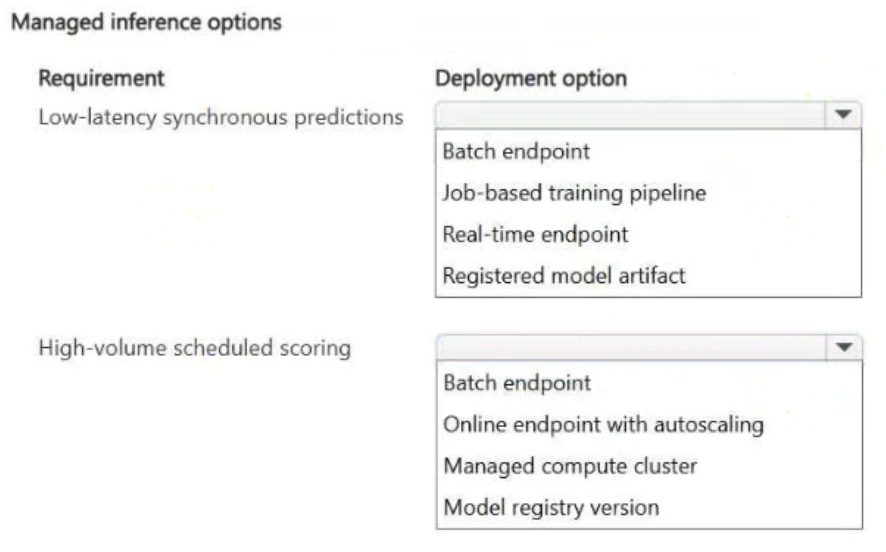
HOTSPOT - A team trains an MLflow model that scores customer churn risk. The model will be consumed by different downstream systems. One system requests predictions synchronously during customer interactions. Another system submits files containing millions of records for scheduled scoring. You need to deploy the model by using managed inference options that match each usage pattern. Which option should you use for each usage pattern? To answer, select the appropriate options in the answer area. NOTE: Each correct selection is worth one point.
Question 4 of 170
You manage an Azure Machine learning workspace. You develop a machine learning model. You must deploy the model to use a low-priority VM with a pricing discount. You need to deploy the model. Which compute target should you use?
Question 5 of 170
A team manages an Azure Machine Learning workspace where they deploy models to online endpoints. The team needs to introduce a new version of a model to production without disrupting existing users. The team must validate the new version before full rollout. You need to reduce risk during deployment. What should you do?
06
07
08
165 questions still locked
Your preview covered the first 5 questions. Unlock the rest to see every explanation and discussion thread, updated weekly
Save every question as a PDF for offline study or printing.
All 170 questions unlocked
Detailed answer explanations
Community discussions and votes
Weekly question updates
Full refund if you do not pass
Send us your exam result and we refund the purchase.
Stories from the certified
Charles Sirois
Canada
As this was my first certification exam, I was understandably nervous about what to expect. These study materials made the preparation process much easier, and many of the questions closely reflected those on the actual exam.
Lance Chambers
United States
Wasted about a month going through the free dump sites scattered all over reddit, half the answers were wrong and the other half were for a version of the exam that doesn't even exist anymore. Eventually gave in and paid the small fee here, and the difference was night and day.
Alisha Kelly
Italy
Honestly, I had already gone through the official documentation quite thoroughly, but still didn't feel fully confident going in. This helped things finally click for me. I realized I knew the material, but just hadn't connected all the pieces yet.
Casper Claassen
Netherlands
Used this along with Microsoft Learn and the combo worked really well. The practice questions made the stuff I'd read actually stick. Passed first attempt, no complaints from me.
Gabriele Ghesla
Italy
The content is accurate and clearly presented, and it's more affordable than competitors. The team has been incredibly responsive whenever I've had an issue, and they've been open to small changes that improve the platform.
Charles Sirois
Canada
As this was my first certification exam, I was understandably nervous about what to expect. These study materials made the preparation process much easier, and many of the questions closely reflected those on the actual exam.
Lance Chambers
United States
Wasted about a month going through the free dump sites scattered all over reddit, half the answers were wrong and the other half were for a version of the exam that doesn't even exist anymore. Eventually gave in and paid the small fee here, and the difference was night and day.
Alisha Kelly
Italy
Honestly, I had already gone through the official documentation quite thoroughly, but still didn't feel fully confident going in. This helped things finally click for me. I realized I knew the material, but just hadn't connected all the pieces yet.
Casper Claassen
Netherlands
Used this along with Microsoft Learn and the combo worked really well. The practice questions made the stuff I'd read actually stick. Passed first attempt, no complaints from me.
Gabriele Ghesla
Italy
The content is accurate and clearly presented, and it's more affordable than competitors. The team has been incredibly responsive whenever I've had an issue, and they've been open to small changes that improve the platform.
Morgan Farmer
United Kingdom
I don't usually leave reviews, but this one felt worth sharing. The questions were quite close to what actually appeared on the exam, more than I expected. I spent about a week going through the material before my test, and it helped me feel more prepared.
Remi Nuyts
United States
Passed ITIL 4 Foundation with 87%. Material was enough by itself.
Archie Hopkins
United States
I had a smooth experience from start to finish. Access was available right away, no technical issues, which made it easy to get started. The content felt relevant and aligned well with what I was looking for.
Nancy Mcbride
United States
Does what it says it does. Content felt solid, nothing confusing to navigate and I didn't run into any weird issues. I been putting off scheduling the exam for a while and going through this gave me enough confidence to finally book it and pass.
Neil Savage
United States
A very quick response was received via email when a link issue occurred. The study materials provided were high quality and extremely helpful. I was able to complete the test successfully. Many thanks for the excellent support.
Morgan Farmer
United Kingdom
I don't usually leave reviews, but this one felt worth sharing. The questions were quite close to what actually appeared on the exam, more than I expected. I spent about a week going through the material before my test, and it helped me feel more prepared.
Remi Nuyts
United States
Passed ITIL 4 Foundation with 87%. Material was enough by itself.
Archie Hopkins
United States
I had a smooth experience from start to finish. Access was available right away, no technical issues, which made it easy to get started. The content felt relevant and aligned well with what I was looking for.
Nancy Mcbride
United States
Does what it says it does. Content felt solid, nothing confusing to navigate and I didn't run into any weird issues. I been putting off scheduling the exam for a while and going through this gave me enough confidence to finally book it and pass.
Neil Savage
United States
A very quick response was received via email when a link issue occurred. The study materials provided were high quality and extremely helpful. I was able to complete the test successfully. Many thanks for the excellent support.
Before you buy
Answers about access, updates, payments, and the refund policy.
01Are these real exam questions?
Our Microsoft AI-300 questions are based on real exam experiences and are regularly updated to match the current exam format. Most candidates who study with us report passing on their first attempt, based on a self reported post exam survey.
02What happens if I don't pass the exam?
With our Premium package, you get a 100% money back guarantee. If you don't pass your exam after studying with our materials, simply contact us with your exam results and we'll refund your purchase.
03How often are the questions updated?
Our question bank is updated regularly based on feedback from recent exam takers. We typically review and update our content every week with reports about new questions or changes to the exam format.
04What does Premium add on the exam page?
Both plans open the full question bank, the explanations, and the discussions. Premium also includes the printable PDF and advanced study tools, giving you full control over how many questions you see per page, quick navigation to any page, and the ability to resume exactly where you left off.
05Is this a single payment or a subscription?
This is a single payment with no recurring charges. Once you purchase, you get full access to all exam questions for the duration of your package (30 days for Standard, 90 days for Premium). No hidden fees or automatic renewals.
06How many questions are included?
You get access to all 170 questions in our database for the Microsoft AI-300 exam. This includes detailed explanations and answer justifications to help you understand the concepts thoroughly.
07Do you offer technical support?
Yes. Email us at hello@examice.com for help with access, billing, or the platform. We read every message and typically reply within 24 hours on business days.
08Is my payment secure?
Absolutely! We use industry standard SSL encryption and process all payments through Stripe, a trusted payment processor used by millions of businesses worldwide. Your payment and personal information are completely secure.
Ready to unlock the rest
All 170 questions from $25, single payment, instant access.