Skip to content

Designing and Building Integrated AI Agent Solutions in Copilot Studio

Here you have the best Microsoft AB-620 practice exam questions

  • Preview the first 5 of 84 questions for free
  • These questions were last updated on July 21, 2026
  • This site is not affiliated with or endorsed by Microsoft.
Question 1 of 84

DRAG DROP -

Case Study -
This is a case study. Case studies are not timed separately from other exam sections. You can use as much exam time as you would like to complete each case study. However, there might be additional case studies or other exam sections. Manage your time to ensure that you can complete all the exam sections in the time provided. Pay attention to the Exam Progress at the top of the screen so you have sufficient time to complete any exam sections that follow this case study.
To answer the case study questions, you will need to reference information that is provided in the case. Case studies and associated questions might contain exhibits or other resources that provide more information about the scenario described in the case. Information provided in an individual question does not apply to the other questions in the case study.
A Review Screen will appear at the end of this case study. From the Review Screen, you can review and change your answers before you move to the next exam section. After you leave this case study, you will NOT be able to return to it.

To start the case study -
To display the first question in this case study, select the "Next" button. To the left of the question, a menu provides links to information such as business requirements, the existing environment, and problem statements. Please read through all this information before answering any questions. When you are ready to answer a question, select the "Question" button to return to the question.

Background -
Blue Yonder Airlines is a global carrier headquartered in Los Angeles, California, operating domestic and international flights. The company serves millions of passengers annually through its website, mobile app, and call centers. To improve customer service efficiency and reduce call center volume, Blue Yonder is deploying an AI agent in Microsoft Copilot Studio.
The agent will handle customer inquiries across multiple channels – web chat, mobile app, and Microsoft Teams (for internal support staff). It will answer questions, retrieve data from enterprise systems, and escalate to human agents when needed.
The project is led by a cross-function team:
Product manager: Defines requirements and success metrics.
Lead agent author: Designs topics, intents, and generative behavior.
Flow designers: Build agent flows and integrations.
IT/security and compliance: Oversees identity, data protection, and Responsible AI (RAI) compliance.

Current environment -

Channels -
Public website: Embedded web chat

Mobile app: In-app chatbot -
Microsoft Teams: Internal support agent access

Identity and access -
Customers: Anonymous access for general inquiries (e.g., flight status, baggage policy).
Authentication is required for personal data access (e.g., bookings, loyalty points).
Internal staff: Authenticate via Microsoft Entra ID.

Data sources -
Reservation and Ticketing System (internal): REST API, no prebuilt connector with custom enterprise database.
Flight Status and Weather APIs (external): REST APIs with API keys.
Customer Support Knowledge Base: SharePoint library with PDFs and policy documents.
Loyalty Program Data: Stored in Dynamics 365 and Dataverse.
Travel Advisory Content: Uses REST API with partner services.

Integration mechanisms -
Custom connectors must be used for internal APIs that lack prebuilt connectors.
HTTP request nodes may be used for lightweight external APIs.
Knowledge sources must be used for unstructured content.
Agent flows must be used to encapsulate reusable logic (e.g., rebooking).

Business requirements -

Omnichannel support -
Deploy the agent across web, mobile, and Teams with a consistent user experience. The Teams deployment must also support internal staff.

Self-service capabilities -
The agent must handle common inquiries such as:

Flight status -

Booking and rebooking -

Loyalty program questions -
Travel policies and baggage rules

Human escalation -
If the agent cannot resolve an issue or the user requests help, it must:
Escalate to a human agent.
Transfer the conversation transcript and relevant context.
Redact any sensitive personal data before escalation.

Knowledge integration -
The agent must use scalable methods for knowledge integration and must not rely on manually authored Q&A topics for each document.

Performance metrics -
First-contact resolution: +25%
Tier-1 call deflection: ≥20%
Response time: 90% of queries answered within 30 seconds

Accuracy: ≥95% for known FAQs -
CSAT: ≥85% for AI-handled interactions

Technical requirements -

Platform constraints -
No custom code is permitted; only Copilot Studio's built-in tools may be used.
All backend logic must be implemented using agent flows.
Markdown must be used for formatting (e.g., bold, bullet points); HTML is not supported.

Authentication -
Sign-in is required for personal data access.
Anonymous access is allowed for general inquiries.
User identity must be used for data access; shared or builder credentials must not be used.

Compliance and security -
Power Platform DLP policies must be enforced to block unauthorized data flows.
Responsible AI content moderation filters must be enabled.
Prompt modifications must be added to enforce tone, disclaimers, and refusal behavior.
Disclaimers must be applied consistently across all generative responses. Manual edits to individual topics must be avoided.

Monitoring and maintenance -
All conversations and actions must be logged for auditing.
Weekly reviews of transcripts and metrics must be conducted.


Issues and constraints -
API rate limits: External APIs (e.g., flight status) have usage limits. Agent flows must handle retries and caching to avoid exceeding quotas.
Knowledge base limits: Copilot Studio has limits on the number and size of indexed documents. Large files must be split or summarized.
Generative answer risks: Generative responses must be constrained to avoid policy violations. Prompt modifications and filters must be used to enforce tone, safety, and compliance.
User input variability: Users phrase questions in diverse ways. Topics must include varied trigger phrases and fallback handling.
Authentication UX: The agent must clearly explain when sign-in is required and handle transitions smoothly across channels.

Problem statement -
Blue Yonder Airlines must deploy a secure, scalable, and policy-compliant AI agent using Microsoft Copilot Studio. The agent must deliver accurate, helpful, and safe responses across multiple channels, integrate with enterprise systems, and support both anonymous and authenticated users. It must adhere to strict data protection and Responsible AI standards while improving customer service efficiency and satisfaction.
You need to configure the agent in Copilot Studio to meet Blue Vender's Responsible AI and data protection requirements.
Which three actions should you perform in sequence? To answer, move the appropriate actions from the list of actions to the answer area and arrange them in the correct order.
Exam ab-620: Image 1
Answer

Suggested Answer

Question 2 of 84

DRAG DROP -

Case Study -
This is a case study. Case studies are not timed separately from other exam sections. You can use as much exam time as you would like to complete each case study. However, there might be additional case studies or other exam sections. Manage your time to ensure that you can complete all the exam sections in the time provided. Pay attention to the Exam Progress at the top of the screen so you have sufficient time to complete any exam sections that follow this case study.
To answer the case study questions, you will need to reference information that is provided in the case. Case studies and associated questions might contain exhibits or other resources that provide more information about the scenario described in the case. Information provided in an individual question does not apply to the other questions in the case study.
A Review Screen will appear at the end of this case study. From the Review Screen, you can review and change your answers before you move to the next exam section. After you leave this case study, you will NOT be able to return to it.

To start the case study -
To display the first question in this case study, select the "Next" button. To the left of the question, a menu provides links to information such as business requirements, the existing environment, and problem statements. Please read through all this information before answering any questions. When you are ready to answer a question, select the "Question" button to return to the question.

Background -
Blue Yonder Airlines is a global carrier headquartered in Los Angeles, California, operating domestic and international flights. The company serves millions of passengers annually through its website, mobile app, and call centers. To improve customer service efficiency and reduce call center volume, Blue Yonder is deploying an AI agent in Microsoft Copilot Studio.
The agent will handle customer inquiries across multiple channels – web chat, mobile app, and Microsoft Teams (for internal support staff). It will answer questions, retrieve data from enterprise systems, and escalate to human agents when needed.
The project is led by a cross-function team:
Product manager: Defines requirements and success metrics.
Lead agent author: Designs topics, intents, and generative behavior.
Flow designers: Build agent flows and integrations.
IT/security and compliance: Oversees identity, data protection, and Responsible AI (RAI) compliance.

Current environment -

Channels -
Public website: Embedded web chat

Mobile app: In-app chatbot -
Microsoft Teams: Internal support agent access

Identity and access -
Customers: Anonymous access for general inquiries (e.g., flight status, baggage policy).
Authentication is required for personal data access (e.g., bookings, loyalty points).
Internal staff: Authenticate via Microsoft Entra ID.

Data sources -
Reservation and Ticketing System (internal): REST API, no prebuilt connector with custom enterprise database.
Flight Status and Weather APIs (external): REST APIs with API keys.
Customer Support Knowledge Base: SharePoint library with PDFs and policy documents.
Loyalty Program Data: Stored in Dynamics 365 and Dataverse.
Travel Advisory Content: Uses REST API with partner services.

Integration mechanisms -
Custom connectors must be used for internal APIs that lack prebuilt connectors.
HTTP request nodes may be used for lightweight external APIs.
Knowledge sources must be used for unstructured content.
Agent flows must be used to encapsulate reusable logic (e.g., rebooking).

Business requirements -

Omnichannel support -
Deploy the agent across web, mobile, and Teams with a consistent user experience. The Teams deployment must also support internal staff.

Self-service capabilities -
The agent must handle common inquiries such as:

Flight status -

Booking and rebooking -

Loyalty program questions -
Travel policies and baggage rules

Human escalation -
If the agent cannot resolve an issue or the user requests help, it must:
Escalate to a human agent.
Transfer the conversation transcript and relevant context.
Redact any sensitive personal data before escalation.

Knowledge integration -
The agent must use scalable methods for knowledge integration and must not rely on manually authored Q&A topics for each document.

Performance metrics -
First-contact resolution: +25%
Tier-1 call deflection: ≥20%
Response time: 90% of queries answered within 30 seconds

Accuracy: ≥95% for known FAQs -
CSAT: ≥85% for AI-handled interactions

Technical requirements -

Platform constraints -
No custom code is permitted; only Copilot Studio's built-in tools may be used.
All backend logic must be implemented using agent flows.
Markdown must be used for formatting (e.g., bold, bullet points); HTML is not supported.

Authentication -
Sign-in is required for personal data access.
Anonymous access is allowed for general inquiries.
User identity must be used for data access; shared or builder credentials must not be used.

Compliance and security -
Power Platform DLP policies must be enforced to block unauthorized data flows.
Responsible AI content moderation filters must be enabled.
Prompt modifications must be added to enforce tone, disclaimers, and refusal behavior.
Disclaimers must be applied consistently across all generative responses. Manual edits to individual topics must be avoided.

Monitoring and maintenance -
All conversations and actions must be logged for auditing.
Weekly reviews of transcripts and metrics must be conducted.


Issues and constraints -
API rate limits: External APIs (e.g., flight status) have usage limits. Agent flows must handle retries and caching to avoid exceeding quotas.
Knowledge base limits: Copilot Studio has limits on the number and size of indexed documents. Large files must be split or summarized.
Generative answer risks: Generative responses must be constrained to avoid policy violations. Prompt modifications and filters must be used to enforce tone, safety, and compliance.
User input variability: Users phrase questions in diverse ways. Topics must include varied trigger phrases and fallback handling.
Authentication UX: The agent must clearly explain when sign-in is required and handle transitions smoothly across channels.

Problem statement -
Blue Yonder Airlines must deploy a secure, scalable, and policy-compliant AI agent using Microsoft Copilot Studio. The agent must deliver accurate, helpful, and safe responses across multiple channels, integrate with enterprise systems, and support both anonymous and authenticated users. It must adhere to strict data protection and Responsible AI standards while improving customer service efficiency and satisfaction.
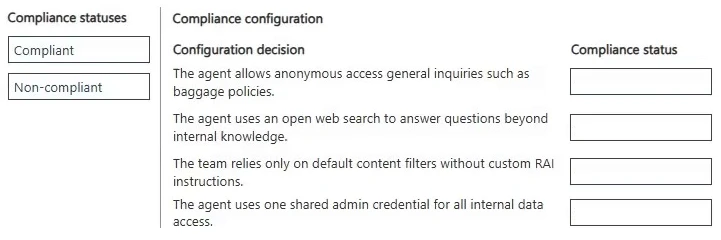
You need to evaluate whether the current configuration decisions for the Blue Yonder Copilot agent comply with the company's security and governance policies.
Which compliance status should you assign to each configuration decision? To answer, move the appropriate compliance statuses to the correct configuration decisions. You may use each compliance status once, more than once, or not at all. You may need to move the split bar between panes or scroll to view content.
NOTE: Each correct selection is worth one point.
Exam ab-620: Image 1
Answer

Suggested Answer

Question 3 of 84

Case Study -
This is a case study. Case studies are not timed separately from other exam sections. You can use as much exam time as you would like to complete each case study. However, there might be additional case studies or other exam sections. Manage your time to ensure that you can complete all the exam sections in the time provided. Pay attention to the Exam Progress at the top of the screen so you have sufficient time to complete any exam sections that follow this case study.
To answer the case study questions, you will need to reference information that is provided in the case. Case studies and associated questions might contain exhibits or other resources that provide more information about the scenario described in the case. Information provided in an individual question does not apply to the other questions in the case study.
A Review Screen will appear at the end of this case study. From the Review Screen, you can review and change your answers before you move to the next exam section. After you leave this case study, you will NOT be able to return to it.

To start the case study -
To display the first question in this case study, select the "Next" button. To the left of the question, a menu provides links to information such as business requirements, the existing environment, and problem statements. Please read through all this information before answering any questions. When you are ready to answer a question, select the "Question" button to return to the question.

Background -
Blue Yonder Airlines is a global carrier headquartered in Los Angeles, California, operating domestic and international flights. The company serves millions of passengers annually through its website, mobile app, and call centers. To improve customer service efficiency and reduce call center volume, Blue Yonder is deploying an AI agent in Microsoft Copilot Studio.
The agent will handle customer inquiries across multiple channels – web chat, mobile app, and Microsoft Teams (for internal support staff). It will answer questions, retrieve data from enterprise systems, and escalate to human agents when needed.
The project is led by a cross-function team:
Product manager: Defines requirements and success metrics.
Lead agent author: Designs topics, intents, and generative behavior.
Flow designers: Build agent flows and integrations.
IT/security and compliance: Oversees identity, data protection, and Responsible AI (RAI) compliance.

Current environment -

Channels -
Public website: Embedded web chat

Mobile app: In-app chatbot -
Microsoft Teams: Internal support agent access

Identity and access -
Customers: Anonymous access for general inquiries (e.g., flight status, baggage policy).
Authentication is required for personal data access (e.g., bookings, loyalty points).
Internal staff: Authenticate via Microsoft Entra ID.

Data sources -
Reservation and Ticketing System (internal): REST API, no prebuilt connector with custom enterprise database.
Flight Status and Weather APIs (external): REST APIs with API keys.
Customer Support Knowledge Base: SharePoint library with PDFs and policy documents.
Loyalty Program Data: Stored in Dynamics 365 and Dataverse.
Travel Advisory Content: Uses REST API with partner services.

Integration mechanisms -
Custom connectors must be used for internal APIs that lack prebuilt connectors.
HTTP request nodes may be used for lightweight external APIs.
Knowledge sources must be used for unstructured content.
Agent flows must be used to encapsulate reusable logic (e.g., rebooking).

Business requirements -

Omnichannel support -
Deploy the agent across web, mobile, and Teams with a consistent user experience. The Teams deployment must also support internal staff.

Self-service capabilities -
The agent must handle common inquiries such as:

Flight status -

Booking and rebooking -

Loyalty program questions -
Travel policies and baggage rules

Human escalation -
If the agent cannot resolve an issue or the user requests help, it must:
Escalate to a human agent.
Transfer the conversation transcript and relevant context.
Redact any sensitive personal data before escalation.

Knowledge integration -
The agent must use scalable methods for knowledge integration and must not rely on manually authored Q&A topics for each document.

Performance metrics -
First-contact resolution: +25%
Tier-1 call deflection: ≥20%
Response time: 90% of queries answered within 30 seconds

Accuracy: ≥95% for known FAQs -
CSAT: ≥85% for AI-handled interactions

Technical requirements -

Platform constraints -
No custom code is permitted; only Copilot Studio's built-in tools may be used.
All backend logic must be implemented using agent flows.
Markdown must be used for formatting (e.g., bold, bullet points); HTML is not supported.

Authentication -
Sign-in is required for personal data access.
Anonymous access is allowed for general inquiries.
User identity must be used for data access; shared or builder credentials must not be used.

Compliance and security -
Power Platform DLP policies must be enforced to block unauthorized data flows.
Responsible AI content moderation filters must be enabled.
Prompt modifications must be added to enforce tone, disclaimers, and refusal behavior.
Disclaimers must be applied consistently across all generative responses. Manual edits to individual topics must be avoided.

Monitoring and maintenance -
All conversations and actions must be logged for auditing.
Weekly reviews of transcripts and metrics must be conducted.


Issues and constraints -
API rate limits: External APIs (e.g., flight status) have usage limits. Agent flows must handle retries and caching to avoid exceeding quotas.
Knowledge base limits: Copilot Studio has limits on the number and size of indexed documents. Large files must be split or summarized.
Generative answer risks: Generative responses must be constrained to avoid policy violations. Prompt modifications and filters must be used to enforce tone, safety, and compliance.
User input variability: Users phrase questions in diverse ways. Topics must include varied trigger phrases and fallback handling.
Authentication UX: The agent must clearly explain when sign-in is required and handle transitions smoothly across channels.

Problem statement -
Blue Yonder Airlines must deploy a secure, scalable, and policy-compliant AI agent using Microsoft Copilot Studio. The agent must deliver accurate, helpful, and safe responses across multiple channels, integrate with enterprise systems, and support both anonymous and authenticated users. It must adhere to strict data protection and Responsible AI standards while improving customer service efficiency and satisfaction.
You need to deploy the Blue Yonder Copilot agent to the public website and Microsoft Teams while ensuring compliance with the company's security and Responsible AI requirements.
Which two actions should you perform before making the agent available on both channels? Each correct answer presents part of the solution.
NOTE: Each correct selection is worth one point.
Answer

Suggested Answer

The suggested answer is A, E.

Community Votes2 votes
ADMost voted
100%
Question 4 of 84

Case Study -
This is a case study. Case studies are not timed separately from other exam sections. You can use as much exam time as you would like to complete each case study. However, there might be additional case studies or other exam sections. Manage your time to ensure that you can complete all the exam sections in the time provided. Pay attention to the Exam Progress at the top of the screen so you have sufficient time to complete any exam sections that follow this case study.
To answer the case study questions, you will need to reference information that is provided in the case. Case studies and associated questions might contain exhibits or other resources that provide more information about the scenario described in the case. Information provided in an individual question does not apply to the other questions in the case study.
A Review Screen will appear at the end of this case study. From the Review Screen, you can review and change your answers before you move to the next exam section. After you leave this case study, you will NOT be able to return to it.

To start the case study -
To display the first question in this case study, select the "Next" button. To the left of the question, a menu provides links to information such as business requirements, the existing environment, and problem statements. Please read through all this information before answering any questions. When you are ready to answer a question, select the "Question" button to return to the question.

Background -
Blue Yonder Airlines is a global carrier headquartered in Los Angeles, California, operating domestic and international flights. The company serves millions of passengers annually through its website, mobile app, and call centers. To improve customer service efficiency and reduce call center volume, Blue Yonder is deploying an AI agent in Microsoft Copilot Studio.
The agent will handle customer inquiries across multiple channels – web chat, mobile app, and Microsoft Teams (for internal support staff). It will answer questions, retrieve data from enterprise systems, and escalate to human agents when needed.
The project is led by a cross-function team:
Product manager: Defines requirements and success metrics.
Lead agent author: Designs topics, intents, and generative behavior.
Flow designers: Build agent flows and integrations.
IT/security and compliance: Oversees identity, data protection, and Responsible AI (RAI) compliance.

Current environment -

Channels -
Public website: Embedded web chat

Mobile app: In-app chatbot -
Microsoft Teams: Internal support agent access

Identity and access -
Customers: Anonymous access for general inquiries (e.g., flight status, baggage policy).
Authentication is required for personal data access (e.g., bookings, loyalty points).
Internal staff: Authenticate via Microsoft Entra ID.

Data sources -
Reservation and Ticketing System (internal): REST API, no prebuilt connector with custom enterprise database.
Flight Status and Weather APIs (external): REST APIs with API keys.
Customer Support Knowledge Base: SharePoint library with PDFs and policy documents.
Loyalty Program Data: Stored in Dynamics 365 and Dataverse.
Travel Advisory Content: Uses REST API with partner services.

Integration mechanisms -
Custom connectors must be used for internal APIs that lack prebuilt connectors.
HTTP request nodes may be used for lightweight external APIs.
Knowledge sources must be used for unstructured content.
Agent flows must be used to encapsulate reusable logic (e.g., rebooking).

Business requirements -

Omnichannel support -
Deploy the agent across web, mobile, and Teams with a consistent user experience. The Teams deployment must also support internal staff.

Self-service capabilities -
The agent must handle common inquiries such as:

Flight status -

Booking and rebooking -

Loyalty program questions -
Travel policies and baggage rules

Human escalation -
If the agent cannot resolve an issue or the user requests help, it must:
Escalate to a human agent.
Transfer the conversation transcript and relevant context.
Redact any sensitive personal data before escalation.

Knowledge integration -
The agent must use scalable methods for knowledge integration and must not rely on manually authored Q&A topics for each document.

Performance metrics -
First-contact resolution: +25%
Tier-1 call deflection: ≥20%
Response time: 90% of queries answered within 30 seconds

Accuracy: ≥95% for known FAQs -
CSAT: ≥85% for AI-handled interactions

Technical requirements -

Platform constraints -
No custom code is permitted; only Copilot Studio's built-in tools may be used.
All backend logic must be implemented using agent flows.
Markdown must be used for formatting (e.g., bold, bullet points); HTML is not supported.

Authentication -
Sign-in is required for personal data access.
Anonymous access is allowed for general inquiries.
User identity must be used for data access; shared or builder credentials must not be used.

Compliance and security -
Power Platform DLP policies must be enforced to block unauthorized data flows.
Responsible AI content moderation filters must be enabled.
Prompt modifications must be added to enforce tone, disclaimers, and refusal behavior.
Disclaimers must be applied consistently across all generative responses. Manual edits to individual topics must be avoided.

Monitoring and maintenance -
All conversations and actions must be logged for auditing.
Weekly reviews of transcripts and metrics must be conducted.


Issues and constraints -
API rate limits: External APIs (e.g., flight status) have usage limits. Agent flows must handle retries and caching to avoid exceeding quotas.
Knowledge base limits: Copilot Studio has limits on the number and size of indexed documents. Large files must be split or summarized.
Generative answer risks: Generative responses must be constrained to avoid policy violations. Prompt modifications and filters must be used to enforce tone, safety, and compliance.
User input variability: Users phrase questions in diverse ways. Topics must include varied trigger phrases and fallback handling.
Authentication UX: The agent must clearly explain when sign-in is required and handle transitions smoothly across channels.

Problem statement -
Blue Yonder Airlines must deploy a secure, scalable, and policy-compliant AI agent using Microsoft Copilot Studio. The agent must deliver accurate, helpful, and safe responses across multiple channels, integrate with enterprise systems, and support both anonymous and authenticated users. It must adhere to strict data protection and Responsible AI standards while improving customer service efficiency and satisfaction.
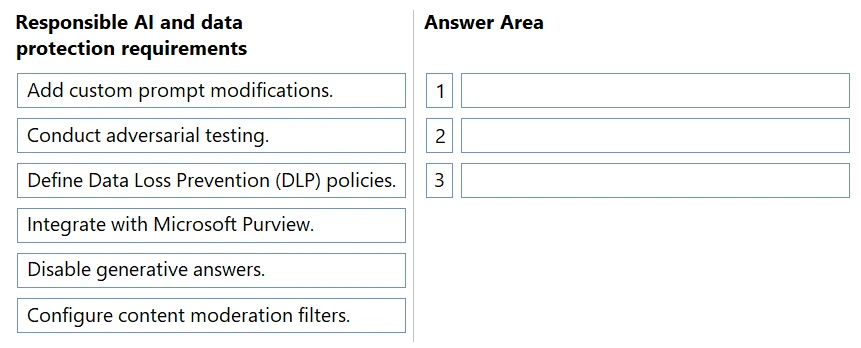
You need to configure the Blue Yonder Copilot agent's responses in accordance with the company's content control and platform requirements.
Which two actions should you perform? Each correct answer presents part of the solution.
NOTE: Each correct selection is worth one point.
Answer

Suggested Answer

The suggested answer is B, C.

Question 5 of 84

Case Study -
This is a case study. Case studies are not timed separately from other exam sections. You can use as much exam time as you would like to complete each case study. However, there might be additional case studies or other exam sections. Manage your time to ensure that you can complete all the exam sections in the time provided. Pay attention to the Exam Progress at the top of the screen so you have sufficient time to complete any exam sections that follow this case study.
To answer the case study questions, you will need to reference information that is provided in the case. Case studies and associated questions might contain exhibits or other resources that provide more information about the scenario described in the case. Information provided in an individual question does not apply to the other questions in the case study.
A Review Screen will appear at the end of this case study. From the Review Screen, you can review and change your answers before you move to the next exam section. After you leave this case study, you will NOT be able to return to it.

To start the case study -
To display the first question in this case study, select the "Next" button. To the left of the question, a menu provides links to information such as business requirements, the existing environment, and problem statements. Please read through all this information before answering any questions. When you are ready to answer a question, select the "Question" button to return to the question.

Background -
Blue Yonder Airlines is a global carrier headquartered in Los Angeles, California, operating domestic and international flights. The company serves millions of passengers annually through its website, mobile app, and call centers. To improve customer service efficiency and reduce call center volume, Blue Yonder is deploying an AI agent in Microsoft Copilot Studio.
The agent will handle customer inquiries across multiple channels – web chat, mobile app, and Microsoft Teams (for internal support staff). It will answer questions, retrieve data from enterprise systems, and escalate to human agents when needed.
The project is led by a cross-function team:
Product manager: Defines requirements and success metrics.
Lead agent author: Designs topics, intents, and generative behavior.
Flow designers: Build agent flows and integrations.
IT/security and compliance: Oversees identity, data protection, and Responsible AI (RAI) compliance.

Current environment -

Channels -
Public website: Embedded web chat

Mobile app: In-app chatbot -
Microsoft Teams: Internal support agent access

Identity and access -
Customers: Anonymous access for general inquiries (e.g., flight status, baggage policy).
Authentication is required for personal data access (e.g., bookings, loyalty points).
Internal staff: Authenticate via Microsoft Entra ID.

Data sources -
Reservation and Ticketing System (internal): REST API, no prebuilt connector with custom enterprise database.
Flight Status and Weather APIs (external): REST APIs with API keys.
Customer Support Knowledge Base: SharePoint library with PDFs and policy documents.
Loyalty Program Data: Stored in Dynamics 365 and Dataverse.
Travel Advisory Content: Uses REST API with partner services.

Integration mechanisms -
Custom connectors must be used for internal APIs that lack prebuilt connectors.
HTTP request nodes may be used for lightweight external APIs.
Knowledge sources must be used for unstructured content.
Agent flows must be used to encapsulate reusable logic (e.g., rebooking).

Business requirements -

Omnichannel support -
Deploy the agent across web, mobile, and Teams with a consistent user experience. The Teams deployment must also support internal staff.

Self-service capabilities -
The agent must handle common inquiries such as:

Flight status -

Booking and rebooking -

Loyalty program questions -
Travel policies and baggage rules

Human escalation -
If the agent cannot resolve an issue or the user requests help, it must:
Escalate to a human agent.
Transfer the conversation transcript and relevant context.
Redact any sensitive personal data before escalation.

Knowledge integration -
The agent must use scalable methods for knowledge integration and must not rely on manually authored Q&A topics for each document.

Performance metrics -
First-contact resolution: +25%
Tier-1 call deflection: ≥20%
Response time: 90% of queries answered within 30 seconds

Accuracy: ≥95% for known FAQs -
CSAT: ≥85% for AI-handled interactions

Technical requirements -

Platform constraints -
No custom code is permitted; only Copilot Studio's built-in tools may be used.
All backend logic must be implemented using agent flows.
Markdown must be used for formatting (e.g., bold, bullet points); HTML is not supported.

Authentication -
Sign-in is required for personal data access.
Anonymous access is allowed for general inquiries.
User identity must be used for data access; shared or builder credentials must not be used.

Compliance and security -
Power Platform DLP policies must be enforced to block unauthorized data flows.
Responsible AI content moderation filters must be enabled.
Prompt modifications must be added to enforce tone, disclaimers, and refusal behavior.
Disclaimers must be applied consistently across all generative responses. Manual edits to individual topics must be avoided.

Monitoring and maintenance -
All conversations and actions must be logged for auditing.
Weekly reviews of transcripts and metrics must be conducted.


Issues and constraints -
API rate limits: External APIs (e.g., flight status) have usage limits. Agent flows must handle retries and caching to avoid exceeding quotas.
Knowledge base limits: Copilot Studio has limits on the number and size of indexed documents. Large files must be split or summarized.
Generative answer risks: Generative responses must be constrained to avoid policy violations. Prompt modifications and filters must be used to enforce tone, safety, and compliance.
User input variability: Users phrase questions in diverse ways. Topics must include varied trigger phrases and fallback handling.
Authentication UX: The agent must clearly explain when sign-in is required and handle transitions smoothly across channels.

Problem statement -
Blue Yonder Airlines must deploy a secure, scalable, and policy-compliant AI agent using Microsoft Copilot Studio. The agent must deliver accurate, helpful, and safe responses across multiple channels, integrate with enterprise systems, and support both anonymous and authenticated users. It must adhere to strict data protection and Responsible AI standards while improving customer service efficiency and satisfaction.
You need to configure the agent in Copilot Studio to use internal and external partner knowledge sources to answer user questions about the airline services.
Which two actions should you perform? Each correct answer presents part of the solution.
NOTE: Each correct selection is worth one point.
Answer

Suggested Answer

The suggested answer is A, D.

79 more questions await

Unlock the full Microsoft AB-620 question bank

5 of 84 completed6%

Choose your plan

Single payment · No subscription · No hidden fees

Standard

Quick preparation

$25

30 days access

30 day access to all questions
Instant free updates
Highest passing rate in industry
Printable PDF download
No money back guarantee
Best Value

Premium

Guaranteed success

$60$35

90 days access

PDF

Printable PDF download

New

Save every question as a PDF for offline study or printing.

90 day access to all questions
Instant free updates
Highest passing rate in industry
Pass guaranteed or money back

100% Money Back Guarantee

Don't pass? Full refund.

4.9/5

Based on 9,128+ reviews

Trusted by thousands of professionals

Join certified professionals who passed their exams with Examice

Examice helped me pass my AWS certification on the first try! The questions were incredibly similar to the real exam. Comments helped me understand answers I was struggling with.
S
Sarah C.
Cloud Engineer
Great results in a short prep time. Passed on my first attempt.
D
David K.
Network Engineer
I needed to pass an exam for work, and this website delivered. The quality for the price is outstanding, and the support is really good. I passed without issues.
M
Michael R.
Security Analyst
Skeptical at first, but impressed. Every question included clear, detailed explanations.
L
Lisa M.
Solutions Architect
The guarantee gave me confidence to invest in the premium package. Turns out I didn't need it. Passed comfortably. The explanations for each answer were incredibly detailed and helped me grasp security concepts that I'd been struggling with for months.
R
Robert H.
Cybersecurity Consultant
Used Examice for my PMP certification. The questions were well structured and covered all exam domains thoroughly.
J
James T.
IT Manager
After failing my first attempt with other study materials, I switched to Examice and passed confidently on my second attempt.
A
Anna W.
Data Engineer
The premium package was worth it. 90 days of access gave me the flexibility to study when it worked for me, without feeling rushed.
E
Emily J.
DevOps Engineer
Straightforward questions that matched the real exam perfectly. Studied for two weeks and passed with a great score.
K
Karen P.
Systems Administrator

Frequently Asked Questions

Everything you need to know. Contact us for more.

Our Microsoft AB-620 questions are based on real exam experiences and are continuously updated to match the current exam format. Most candidates who study with us report passing on their first attempt, based on a self reported post exam survey.

With our Premium package, you get a 100% money back guarantee. If you don't pass your exam after studying with our materials, simply contact us with your exam results and we'll refund your purchase. Terms and conditions apply, read our full refund policy to learn more.

Our question bank is updated regularly based on feedback from recent exam takers. We typically review and update our content every week with reports about new questions or changes to the exam format.

Yes. When your access is close to expiring, you can renew it for another 30 days directly from the exam page. If you need more time while you are still preparing, reach out and we will help.

This is a single payment with no recurring charges. Once you purchase, you get full access to all exam questions for the duration of your package (30 days for Standard, 90 days for Premium). No hidden fees or automatic renewals.

Pass on your first try

All 84questions · Detailed explanations · Printable PDF · 90 days access

Money back guaranteeSecure checkout
$35

single payment