Agentic AI Business Solutions Architect

Here you have the best Microsoft AB-100 practice exam questions

  • You have 56 total questions across 12 pages (5 per page)
  • These questions were last updated on March 11, 2026
  • This site is not affiliated with or endorsed by Microsoft.
Question 1 of 56

DRAG DROP -
A company has an AI solution that uses a Microsoft Copilot Studio agent.
You need to monitor the agent's performance. The solution must meet the following requirements:
Monitor the agent's telemetry in near-real-time (NRT).
Download transcripts of full conversations.
Monitor the agent's usage and performance.
What should you use for each requirement? To answer, drag the appropriate options to the correct requirements. Each option may be used once, more than once, or not at all. You may need to drag the split bar between panes or scroll to view content.
NOTE: Each correct selection is worth one point.
Exam AB-100: Image 1
Answer

Suggested Answer

Question 2 of 56

A company has a Microsoft Copilot Studio agent that provides answers based on a knowledge base for customer support.
Users report that, occasionally, the agent provides inaccurate answers.
You need to use metrics from the Analytics tab in Copilot Studio to identify the cause of the inaccuracies.
Which two options should you use? Each correct answer presents part of the solution.
NOTE: Each correct selection is worth one point.
Answer

Suggested Answer

The suggested answer is C, D.

Community Votes2 votes
BCMost voted
50%
CE
50%
Question 3 of 56

A company plans to deploy an AI-based customer service app that will autonomously manage interactions, escalate complex cases, and learn from historical ticket data.
You need to perform a return on AI investment (ROAI) analysis of the app deployment. The solution must ensure that the analysis is accurate.
What should you do first?
Answer

Suggested Answer

The suggested answer is D.

Community Votes1 vote
DSuggested
100%
Question 4 of 56

Case study -
This is a case study. Case studies are not timed separately from other exam sections. You can use as much exam time as you would like to complete each case study. However, there might be additional case studies or other exam sections. Manage your time to ensure that you can complete all the exam sections in the time provided. Pay attention to the Exam Progress at the top of the screen so you have sufficient time to complete any exam sections that follow this case study.
To answer the case study questions, you will need to reference information that is provided in the case. Case studies and associated questions might contain exhibits or other resources that provide more information about the scenario described in the case. Information provided in an individual question does not apply to the other questions in the case study.
A Review Screen will appear at the end of this case study. From the Review Screen, you can review and change your answers before you move to the next exam section. After you leave this case study, you will NOT be able to return to it.

To start the case study -
To display the first question in this case study, select the "Next" button. To the left of the question, a menu provides links to information such as business requirements, the existing environment, and problem statements. Please read through all this information before answering any questions. When you are ready to answer a question, select the "Question" button to return to the question.

Background -
Fabrikam, Inc., is a global consumer goods company that is undergoing a digital transformation initiative to migrate its entire infrastructure to the Microsoft cloud. As a key element of this cloud migration, the company will implement Microsoft Dynamics 365 Sales, moving away from the current on-premises proprietary technologies used by its business-to-business (B2B) sales team.
As part of the cloud migration, Fabrikam will adopt an AI-first approach to its business solutions and implement AI solutions, wherever possible, to streamline operations.

Problem Statements -
Fabrikam's infrastructure currently relies on various on-premises systems that require sales executives to use corporate computers with physical keyboards to access business information during customer interactions. Mobile phones cannot be used for these purposes, as the systems depend on keyboard input. As a result, the sales executives spend a lot of time using keyboards to search for data on several disparate systems and file servers, rather than focusing on the customers. This affects the customer experience.
Fabrikam stakeholders are concerned that users will be hesitant to adopt AI. If the AI initiatives are NOT adopted, cost savings will never be realized. Additionally, funding for future AI initiatives will depend on demonstrating an increase in AI adoption month over month. As the AI agent initiative for the sales team will be the first for Fabrikam, the rapid adoption of the agent is a high priority.

Planned Initiatives -

General -
Fabrikam management has prioritized AI-driven projects to improve efficiency, customer engagement, and responsible AI adoption. The current application infrastructure is on-premises and must be migrated to the cloud to support the adoption of these technologies.

Infrastructure Migration -
Fabrikam plans to migrate from its current on-premises infrastructure to a completely cloud-based topology; this will include user authentication, the security framework, and, primarily, the adoption of the services by end users.
All the data from the different systems will be consolidated into a single data source - a common data model that will use a Microsoft Dataverse environment as a single source of truth (SSOT) for the sales team.

Sales Cycle Enablement -
To achieve the company's objectives, Fabrikam intends to implement the following strategies to enhance the sales cycle:
Use low-code development to create a single AI agent that has Dataverse as its core component.
Ensure that sales managers can access unanswered correspondence from prospects and intervene as appropriate.
Replace the previous proprietary software with Dynamics 365 Sales to track sales cycles and customer interactions.
Have the sales executives use Dynamics 365 Sales to track interactions for open opportunities and send follow-up communications to prospects.
Have the sales executives use handsfree headsets to interact with an AI agent when they have questions about internal policies or customer data.

Requirements -

Infrastructure Migration -
Fabrikam has identified the following infrastructure migration requirements:
Azure must be used for all future infrastructure workloads.
The company must follow Microsoft-recommended methodologies for infrastructure migration to the cloud.
Any created AI agents must have their return on investment (ROI) calculated to ensure that the solution will save the company money.

Sales Cycle Enablement -
Fabrikam has identified the following requirements for sales cycle enablement:
The final AI agent must follow Microsoft recommendations for a conversational user experience.
A designated checklist must be reviewed to ensure that the AI agent follows Microsoft deployment recommendations for a compliant solution.
Detailed telemetry must be logged for the first created AI agent to help troubleshoot and optimize the agent during the initial AI agent adoption process.
Unexpected AI agent actions must end in an escalation to a live representative. For example, a sales executive must be rerouted to a representative if the agent cannot answer a question after two failed attempts.
The return on investment (ROI) of switching from the current process to the future process is required for stakeholder sign off.
The sales team must use Dynamics 365 Sales to correspond with prospects more quickly and efficiently than currently.
Sales managers must report on the adoption of the AI agent to key Fabrikam stakeholders on a monthly basis.
Any sensitive information, such as user IDs and names, shared via the AI agent must be tracked for future auditing.
Which template should you use for the AI agent to meet the requirements for the sales executives?
Answer

Suggested Answer

The suggested answer is C.

Community Votes1 vote
CSuggested
100%
Question 5 of 56

HOTSPOT -

Case study -
This is a case study. Case studies are not timed separately from other exam sections. You can use as much exam time as you would like to complete each case study. However, there might be additional case studies or other exam sections. Manage your time to ensure that you can complete all the exam sections in the time provided. Pay attention to the Exam Progress at the top of the screen so you have sufficient time to complete any exam sections that follow this case study.
To answer the case study questions, you will need to reference information that is provided in the case. Case studies and associated questions might contain exhibits or other resources that provide more information about the scenario described in the case. Information provided in an individual question does not apply to the other questions in the case study.
A Review Screen will appear at the end of this case study. From the Review Screen, you can review and change your answers before you move to the next exam section. After you leave this case study, you will NOT be able to return to it.

To start the case study -
To display the first question in this case study, select the "Next" button. To the left of the question, a menu provides links to information such as business requirements, the existing environment, and problem statements. Please read through all this information before answering any questions. When you are ready to answer a question, select the "Question" button to return to the question.

Background -
Fabrikam, Inc., is a global consumer goods company that is undergoing a digital transformation initiative to migrate its entire infrastructure to the Microsoft cloud. As a key element of this cloud migration, the company will implement Microsoft Dynamics 365 Sales, moving away from the current on-premises proprietary technologies used by its business-to-business (B2B) sales team.
As part of the cloud migration, Fabrikam will adopt an AI-first approach to its business solutions and implement AI solutions, wherever possible, to streamline operations.

Problem Statements -
Fabrikam's infrastructure currently relies on various on-premises systems that require sales executives to use corporate computers with physical keyboards to access business information during customer interactions. Mobile phones cannot be used for these purposes, as the systems depend on keyboard input. As a result, the sales executives spend a lot of time using keyboards to search for data on several disparate systems and file servers, rather than focusing on the customers. This affects the customer experience.
Fabrikam stakeholders are concerned that users will be hesitant to adopt AI. If the AI initiatives are NOT adopted, cost savings will never be realized. Additionally, funding for future AI initiatives will depend on demonstrating an increase in AI adoption month over month. As the AI agent initiative for the sales team will be the first for Fabrikam, the rapid adoption of the agent is a high priority.

Planned Initiatives -

General -
Fabrikam management has prioritized AI-driven projects to improve efficiency, customer engagement, and responsible AI adoption. The current application infrastructure is on-premises and must be migrated to the cloud to support the adoption of these technologies.

Infrastructure Migration -
Fabrikam plans to migrate from its current on-premises infrastructure to a completely cloud-based topology; this will include user authentication, the security framework, and, primarily, the adoption of the services by end users.
All the data from the different systems will be consolidated into a single data source - a common data model that will use a Microsoft Dataverse environment as a single source of truth (SSOT) for the sales team.

Sales Cycle Enablement -
To achieve the company's objectives, Fabrikam intends to implement the following strategies to enhance the sales cycle:
Use low-code development to create a single AI agent that has Dataverse as its core component.
Ensure that sales managers can access unanswered correspondence from prospects and intervene as appropriate.
Replace the previous proprietary software with Dynamics 365 Sales to track sales cycles and customer interactions.
Have the sales executives use Dynamics 365 Sales to track interactions for open opportunities and send follow-up communications to prospects.
Have the sales executives use handsfree headsets to interact with an AI agent when they have questions about internal policies or customer data.

Requirements -

Infrastructure Migration -
Fabrikam has identified the following infrastructure migration requirements:
Azure must be used for all future infrastructure workloads.
The company must follow Microsoft-recommended methodologies for infrastructure migration to the cloud.
Any created AI agents must have their return on investment (ROI) calculated to ensure that the solution will save the company money.

Sales Cycle Enablement -
Fabrikam has identified the following requirements for sales cycle enablement:
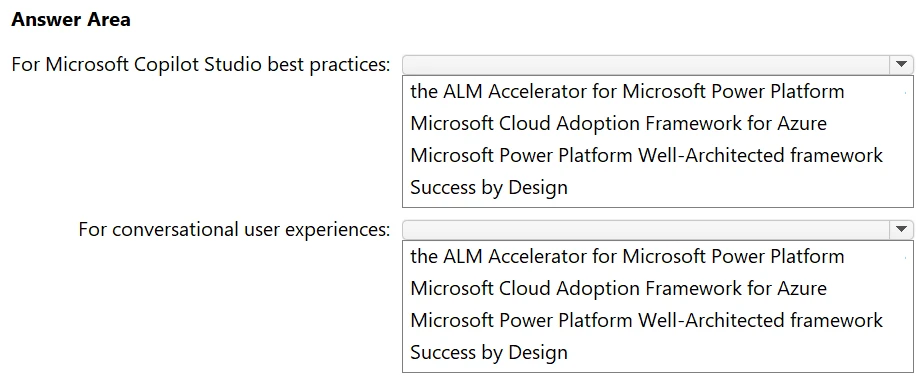
The final AI agent must follow Microsoft recommendations for a conversational user experience.
A designated checklist must be reviewed to ensure that the AI agent follows Microsoft deployment recommendations for a compliant solution.
Detailed telemetry must be logged for the first created AI agent to help troubleshoot and optimize the agent during the initial AI agent adoption process.
Unexpected AI agent actions must end in an escalation to a live representative. For example, a sales executive must be rerouted to a representative if the agent cannot answer a question after two failed attempts.
The return on investment (ROI) of switching from the current process to the future process is required for stakeholder sign off.
The sales team must use Dynamics 365 Sales to correspond with prospects more quickly and efficiently than currently.
Sales managers must report on the adoption of the AI agent to key Fabrikam stakeholders on a monthly basis.
Any sensitive information, such as user IDs and names, shared via the AI agent must be tracked for future auditing.
Which framework should you use to meet the AI agent requirements for the sales cycle enablement? To answer, select the appropriate options in the answer area.
NOTE: Each correct selection is worth one point.
Exam AB-100: Image 1
Answer

Suggested Answer

About the Microsoft AB-100 Certification Exam

About the Exam

The Microsoft AB-100 (Agentic AI Business Solutions Architect) validates your knowledge and skills. Passing demonstrates proficiency and can boost your career prospects in the field.

How to Prepare

Work through all 56 practice questions across 12 pages. Focus on understanding the reasoning behind each answer rather than memorizing responses to be ready for any variation on the real exam.

Why Practice Exams?

Practice exams help you familiarize yourself with the question format, manage your time, and reduce anxiety on the test day. Our AB-100 questions are regularly updated to reflect the latest exam objectives.