Implementing Cisco Service Provider Next-Generation Edge Network Services (SPEDGE)

Here you have the best Cisco 642-889 practice exam questions

  • Preview the first 5 of 126 questions for free
  • These questions were last updated on May 6, 2026
  • This site is not affiliated with or endorsed by Cisco.
Question 1 of 126

Which type of VPN requires a full mesh of virtual circuits to provide optimal site-to-site connectivity?

Answer

Suggested Answer

The suggested answer is B.

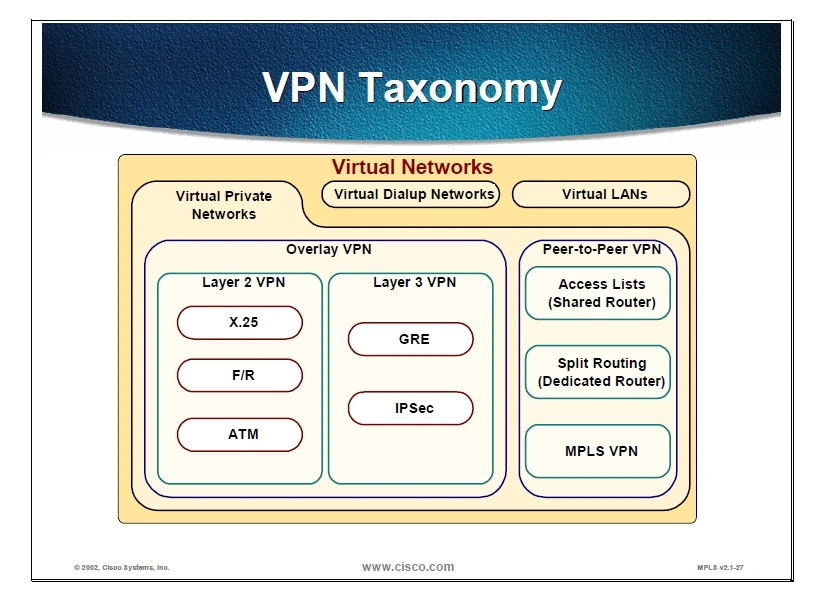
Exam 642-889: Question 1 - Image 1 http://etutorials.org/Networking/MPLS+VPN+Architectures/Part+2+MPLS-based+Virtual+Private+Networks/Chapter+7.+Virtual+Private+Network+VPN
+Implementation+Options/Overlay+and+Peer-to-peer+VPN+Model/
Two VPN implementation models have gained widespread use:
The overlay model, where the service provider provides emulated leased lines to the customer.
The service provider provides the customer with a set of emulated leased lines. These leased lines are called VCs, which can be either constantly available
(PVCs) or established on demand (SVCs). The QoS guarantees in the overlay VPN model usually are expressed in terms of bandwidth guaranteed on a certain
VC (Committed Information Rate or CIR) and maximum bandwidth available on a certain VC (Peak Information Rate or PIR). The committed bandwidth guarantee usually is provided through the statistical nature of the Layer 2 service but depends on the overbooking strategy of the service provider
The peer-to-peer model, where the service provider and the customer exchange Layer 3 routing information and the provider relays the data between the customer sites on the optimum path between the sites and without the customer's involvement.
The peer-to-peer VPN model was introduced a few years ago to alleviate the drawbacks of the overlay VPN model. In the peer-to-peer model, the Provider Edge
.
(PE) device is a router (PE-router) that directly exchanges routing information with the CPE router
The Managed Network service offered by many service
providers, where the service provider also manages the CPE devices, is not relevant to this discussion because it's only a repackaging of another service. The
Managed Network provider concurrently assumes the role of the VPN service provider (providing the VPN infrastructure) and part of the VPN customer role
(managing the CPE device).
The peer-to-peer model provides a number of advantages over the traditional overlay model:
Routing (from the customer's perspective) becomes exceedingly simple, as the customer router exchanges routing information with only one (or a few) PE-router, whereas in the overlay VPN network, the number of neighbor routers can grow to a large number.
Routing between the customer sites is always optimal, as the provider routers know the customer's network topology and can thus establish optimum inter-site routing.
Bandwidth provisioning is simpler because the customer has to specify only the inbound and outbound bandwidths for each site (Committed Access Rate [CAR] and Committed Delivery Rate [CDR]) and not the exact site-to-site traffic profile.
The addition of a new site is simpler because the service provider provisions only an additional site and changes the configuration on the attached PE-router.
Under the overlay VPN model, the service provider must provision a whole set of VCs leading from that site to other sites of the customer VPN.
Prior to an MPLS-based VPN implementation, two implementation options existed for the peer-to-peer VPN model:
The shared-router approach, where several VPN customers share the same PE-router.
The dedicated-router approach, where each VPN customer has dedicated PE-routers.
Overlay VPN paradigm has a number of drawbacks, most significant of them being the need for the customer to establish point-to-point links or virtual circuits between sites. The formula to calculate how many point-to-point links or virtual circuits you need in the worst case is ((n)(n-1))/2, where n is the number of sites you need to connect. For example, if you need to have fullmesh connectivity between 4 sites, you will need a total of 6 point-to-point links or virtual circuits.
To overcome this drawback and provide the customer with optimum data transport across the Service Provider backbone, the peer-to-peer VPN concept was introduced where the Service Provider actively participates in the customer routing, accepting customer routes, transporting them across the Service Provider backbone and finally propagating them to other customer sites. B
Question 2 of 126

Which three Layer 3 VPN technologies are based on the overlay model? (Choose three.)

Answer

Suggested Answer

The suggested answer is C, D, F.

Question 3 of 126

Which VPN technology uses the Group Domain of Interpretation as the keying protocol and IPsec for encryption that is often deployed over a private MPLS core network?

Answer

Suggested Answer

The suggested answer is B.

Question 4 of 126

What is the primary difference between 6PE and 6VPE?

Answer

Suggested Answer

The suggested answer is C.

Question 5 of 126

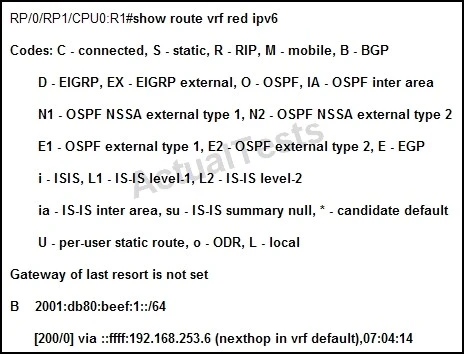
Refer to the Cisco IOS XR router output exhibit,

Exam 642-889: Question 5 - Image 1

which method is being used to transport IPv6 traffic over the service provider network?

121 more questions await

Unlock the full Cisco 642-889 question bank

5 of 126 completed4%

Choose your plan

One-time payment · No subscription · No hidden fees

Standard

Quick preparation

$25

30 days access

30 day access to all questions
Instant free updates
Highest passing rate in industry
Printable PDF download
No money-back guarantee
Best Value

Premium

Guaranteed success

$60$35

90 days access

PDF

Printable PDF download

New

Save every question as a PDF for offline study or printing.

90 day access to all questions
Instant free updates
Highest passing rate in industry
Pass guaranteed or money back

100% Money-Back Guarantee

Don't pass? Full refund.

4.9/5

Based on 4,428+ reviews

Trusted by thousands of professionals

Join certified professionals who passed their exams with Examice

Examice helped me pass my AWS certification on the first try! The questions were incredibly similar to the real exam. Comments helped me understand answers I was struggling with.
S
Sarah C.
Cloud Engineer
Great results in a short prep time. Passed on my first attempt.
D
David K.
Network Engineer
I needed to pass an exam for work, and this website delivered. The quality for the price is outstanding, and the support is really good. I passed without issues.
M
Michael R.
Security Analyst
Skeptical at first, but impressed. Every question included clear, detailed explanations.
L
Lisa M.
Solutions Architect
The guarantee gave me confidence to invest in the premium package. Turns out I didn't need it. Passed comfortably. The explanations for each answer were incredibly detailed and helped me grasp security concepts that I'd been struggling with for months.
R
Robert H.
Cybersecurity Consultant
Used Examice for my PMP certification. The questions were well structured and covered all exam domains thoroughly.
J
James T.
IT Manager
After failing my first attempt with other study materials, I switched to Examice and passed confidently on my second attempt.
A
Anna W.
Data Engineer
The premium package was worth it. 90 days of access gave me the flexibility to study when it worked for me, without feeling rushed.
E
Emily J.
DevOps Engineer
Straightforward questions that matched the real exam perfectly. Studied for two weeks and passed with a great score.
K
Karen P.
Systems Administrator

Frequently Asked Questions

Everything you need to know. Contact us for more.

Our Cisco 642-889 questions are based on real exam experiences and are continuously updated to match the current exam format. We maintain a +99% pass rate because our questions closely mirror what you'll see on the actual exam.

With our Premium package, you get a 100% money-back guarantee. If you don't pass your exam after studying with our materials, simply contact us with your exam results and we'll refund your purchase. Terms and conditions apply, read our full refund policy to learn more.

Our question bank is updated regularly based on feedback from recent exam takers. We typically review and update our content every week with reports about new questions or changes to the exam format.

Standard package access cannot be extended. However, Premium package gives you 90 days which is typically more than enough time to prepare thoroughly. If you need additional time, you can purchase a new package at any time.

This is a one-time payment with no recurring charges. Once you purchase, you get full access to all exam questions for the duration of your package (30 days for Standard, 90 days for Premium). No hidden fees or automatic renewals.

Pass on your first try

All 126questions · Detailed explanations · Printable PDF · 90 days access

Money-back guaranteeSecure checkout
$35

one-time payment