Skip to content

Test Prep EA

Executive Assessment

Verified practice questions with detailed answers, clear explanations, and community discussion.

  • 13

    questions

  • 6 days ago

    last updated

  • 4.8/5

    overall rating

Question 1 of 13

HOTSPOT -
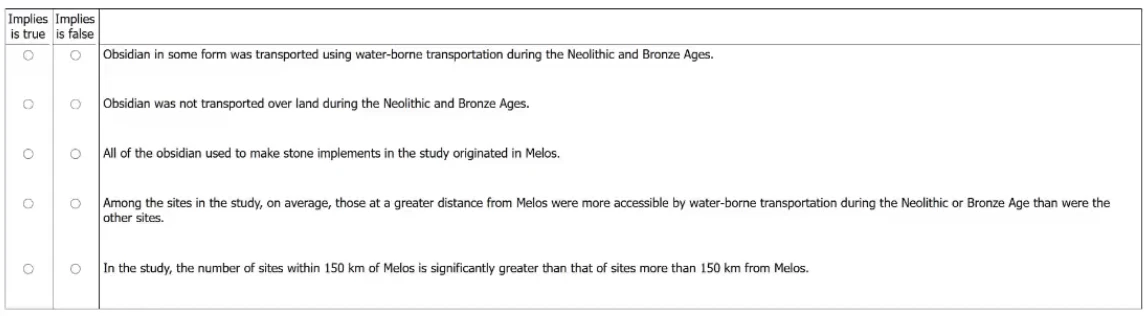
Speaker: The coastal area of Melos, Greece, was a natural source for obsidian, which was highly sought after as material for making many stone implements during the Neolithic Age and the Bronze Age. A study by archaeologists examining stone implements from Neolithic and Bronze Age sites in Greece shows that, of those implements, the percentage made of obsidian varies with those sites' distance from Melos. For sites within 150 kilometers (km), the percentage is 85-100 percent; for those between 150 and 200 km, the percentage is 40-70 percent; and for those greater than 200 km away, the percentage is less than 30 percent. This variation is due to differential access to water-borne transportation.
Select for Implies is true the statement that the speaker’s argument most clearly implies is true, and select for Implies is false the statement that the speaker's argument most dearly implies is false. Make only two selections, one in each column.
Exam EA: Image 1
Show answer

Suggested answer

Implies is true: Obsidian in some form was transported using water-borne transportation during the Neolithic and Bronze Ages. Implies is false: Among the sites in the study, on average, those at a greater distance from Melos were more accessible by water-borne transportation than were the other sites. The higher percentage of Melian obsidian at closer sites is attributed to better access to water-borne transport, so more distant sites cannot have been more accessible on average.

Question 2 of 13

HOTSPOT -
Exam EA: Image 1
At the annual holiday party of a particular company, each person is given a choice of 5 opportunities to win a prize. Specifically, each employee writes his/her name on a piece of paper and places it into one of 5 boxes, with each box representing a particular prize. One name is drawn from each box at random, and the 5 individuals thus named win the respective prizes.
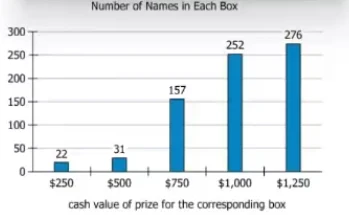
Gertrude is the last person to arrive at the holiday party and to place her name in one of the boxes. She knows, for each of the boxes, the number of individuals who have already placed their names in the box. And she knows the cash value of each of the prizes, in US dollars. This information is reflected in the graph.
Select from the drop-down menus the options that create the most accurate statement about the expected outcomes (the cash value of the prize corresponding to the chosen box multiplied by the probability of winning) of Gertrude's possible choices.
Exam EA: Image 2
Show answer

Suggested answer

$500; roughly $16. Gertrude’s probability of winning a box is one divided by the total number of names in that box after she enters. For the $500 box, the expected value is $500 divided by 32, or about $15.63, which is greater than the expected value for each of the other boxes.

Question 3 of 13

HOTSPOT -

Welleby's Plan -
The water in the underground water table beneath the town of Welleby is moderately saline—20,000 milligrams of salt per liter of water (mg/L), or roughly half as saline as ocean water. To lower the level of the water table and thus prevent agricultural land from being inundated with salt water, the town plans to pump water from the table at a rate of 450 kiloliters per day (kL/day) into a large shallow pond, allowing much of the water to evaporate. The town plans to divert 10 percent of the water pumped from the water table to supplement its supply of drinking water, which is currently piped in from great distances. Due to the water's salinity, the town intends to construct a desalination plant to treat the diverted water for use as drinking water.

Desalination Types -
Welleby is deciding among the following three desalination methods.
Reverse Osmosis (RO): Water is pushed through a membrane, leaving salts behind. RO systems can handle a large range of water flow rates and use relatively little energy. However, RO membranes are expensive and must be replaced every 2 to 5 years. There is also a possibility that bacteria can grow on the membrane, introducing tastes and odors into the desalinated water.
Multi-Effect Distillation (MED): Saline water is heated to produce water vapor, from which is condensed potable fresh water. This process requires large amounts of energy, regardless of the salinity of the source water. It becomes more cost effective as water volumes increase.
Electrodialysis (ED): Electricity is used to selectively move salts through a membrane. Consumption of energy is directly proportional to the salinity of the water to be treated, so with higher salinities the process rapidly becomes more costly than other methods. ED membranes need to be replaced every 7 to 10 years.

Comparison -
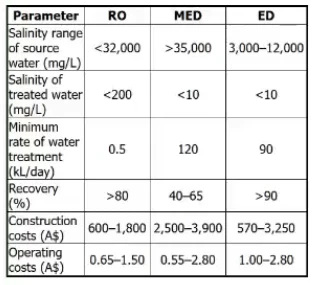
The table presents the recommended parameters of use for Reverse Osmosis (RO), Multi-Effect Distillation (MED), and Electrodialysis (ED), as well as construction costs and operating costs. Costs presented in Australian dollars (A$) represent the cost per kiloliter of treated water per day.
Recovery refers to the percent of source water that is recovered as treated water—potable drinking water.
Exam EA: Image 1
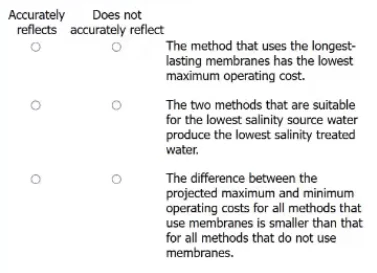
For each of the following statements about the three desalination methods, select Accurately reflects if it accurately reflects the information provided, and otherwise select Does not accurately reflect.
Exam EA: Image 2
Show answer

Suggested answer

1. Does not accurately reflect 2. Does not accurately reflect 3. Accurately reflects ED uses the longest-lasting membranes, but its maximum operating cost of A$2.80 is not the lowest. RO and ED can treat lower-salinity source water, but only ED produces the lowest treated-water salinity. The operating-cost ranges for RO and ED are both smaller than MED’s range.

Question 4 of 13

HOTSPOT -

Welleby's Plan -
The water in the underground water table beneath the town of Welleby is moderately saline—20,000 milligrams of salt per liter of water (mg/L), or roughly half as saline as ocean water. To lower the level of the water table and thus prevent agricultural land from being inundated with salt water, the town plans to pump water from the table at a rate of 450 kiloliters per day (kL/day) into a large shallow pond, allowing much of the water to evaporate. The town plans to divert 10 percent of the water pumped from the water table to supplement its supply of drinking water, which is currently piped in from great distances. Due to the water's salinity, the town intends to construct a desalination plant to treat the diverted water for use as drinking water.

Desalination Types -
Welleby is deciding among the following three desalination methods.
Reverse Osmosis (RO): Water is pushed through a membrane, leaving salts behind. RO systems can handle a large range of water flow rates and use relatively little energy. However, RO membranes are expensive and must be replaced every 2 to 5 years. There is also a possibility that bacteria can grow on the membrane, introducing tastes and odors into the desalinated water.
Multi-Effect Distillation (MED): Saline water is heated to produce water vapor, from which is condensed potable fresh water. This process requires large amounts of energy, regardless of the salinity of the source water. It becomes more cost effective as water volumes increase.
Electrodialysis (ED): Electricity is used to selectively move salts through a membrane. Consumption of energy is directly proportional to the salinity of the water to be treated, so with higher salinities the process rapidly becomes more costly than other methods. ED membranes need to be replaced every 7 to 10 years.

Comparison -
The table presents the recommended parameters of use for Reverse Osmosis (RO), Multi-Effect Distillation (MED), and Electrodialysis (ED), as well as construction costs and operating costs. Costs presented in Australian dollars (A$) represent the cost per kiloliter of treated water per day.
Recovery refers to the percent of source water that is recovered as treated water—potable drinking water.
Exam EA: Image 1
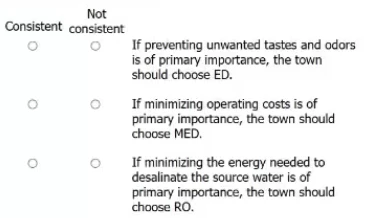
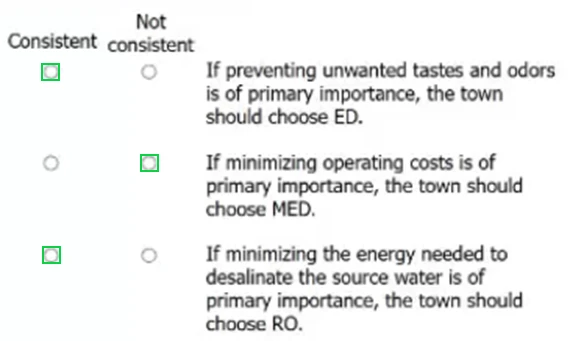
For a town seeking to desalinate source water with a salinity of 12,000 mg/L, select Consistent for each of the following statements that is consistent with the information and recommendations provided, and otherwise select Not consistent.
Exam EA: Image 2
Show answer

Suggested answer

Consistent; Not consistent; Consistent. ED avoids the bacterial membrane-growth issue associated with RO, so it is appropriate when tastes and odors are the primary concern. MED requires large energy inputs and is not the lowest operating-cost choice for 12,000 mg/L source water. RO uses relatively little energy across a broad salinity range.

Question 5 of 13

Welleby's Plan -
The water in the underground water table beneath the town of Welleby is moderately saline—20,000 milligrams of salt per liter of water (mg/L), or roughly half as saline as ocean water. To lower the level of the water table and thus prevent agricultural land from being inundated with salt water, the town plans to pump water from the table at a rate of 450 kiloliters per day (kL/day) into a large shallow pond, allowing much of the water to evaporate. The town plans to divert 10 percent of the water pumped from the water table to supplement its supply of drinking water, which is currently piped in from great distances. Due to the water's salinity, the town intends to construct a desalination plant to treat the diverted water for use as drinking water.

Desalination Types -
Welleby is deciding among the following three desalination methods.
Reverse Osmosis (RO): Water is pushed through a membrane, leaving salts behind. RO systems can handle a large range of water flow rates and use relatively little energy. However, RO membranes are expensive and must be replaced every 2 to 5 years. There is also a possibility that bacteria can grow on the membrane, introducing tastes and odors into the desalinated water.
Multi-Effect Distillation (MED): Saline water is heated to produce water vapor, from which is condensed potable fresh water. This process requires large amounts of energy, regardless of the salinity of the source water. It becomes more cost effective as water volumes increase.
Electrodialysis (ED): Electricity is used to selectively move salts through a membrane. Consumption of energy is directly proportional to the salinity of the water to be treated, so with higher salinities the process rapidly becomes more costly than other methods. ED membranes need to be replaced every 7 to 10 years.

Comparison -
The table presents the recommended parameters of use for Reverse Osmosis (RO), Multi-Effect Distillation (MED), and Electrodialysis (ED), as well as construction costs and operating costs. Costs presented in Australian dollars (A$) represent the cost per kiloliter of treated water per day.
Recovery refers to the percent of source water that is recovered as treated water—potable drinking water.
Exam EA: Image 1
Based on the information provided, which one of the following benefits to Welleby is most likely to result from its building a desalination plant?
Answer choices
Show answer

Correct answer: A

Reduced dependence on distant sources for drinking water results because the desalination plant converts a portion of Welleby’s pumped saline groundwater into potable water. The town currently imports its drinking water over long distances, so locally treating 10 percent of the pumped water supplements that supply. The plant does not reduce pumping costs or the salinity of the remaining underground water, and it does not directly create additional agricultural land.

8 questions still locked

Your preview covered the first 5 questions. Unlock the rest to see every explanation and discussion thread, updated weekly

View plans

Choose your plan

Single payment · No subscription · No hidden fees

Standard

For a focused sprint before your exam date

$25USD

30 days of access, single payment

  • All 13 questions unlocked
  • Detailed answer explanations
  • Community discussions and votes
  • Weekly question updates
  • Printable PDF download
  • 100% refund if you do not pass

Premium

Extra runway, the PDF, and the refund guarantee

$35$60USD

90 days of access, single payment

Printable PDF download

Save every question as a PDF for offline study or printing.

  • All 13 questions unlocked
  • Detailed answer explanations
  • Community discussions and votes
  • Weekly question updates

Full refund if you do not pass

Send us your exam result and we refund the purchase.

Stories from the certified

Charles Sirois
Canada
As this was my first certification exam, I was understandably nervous about what to expect. These study materials made the preparation process much easier, and many of the questions closely reflected those on the actual exam.
Lance Chambers
United States
Wasted about a month going through the free dump sites scattered all over reddit, half the answers were wrong and the other half were for a version of the exam that doesn't even exist anymore. Eventually gave in and paid the small fee here, and the difference was night and day.
Alisha Kelly
Italy
Honestly, I had already gone through the official documentation quite thoroughly, but still didn't feel fully confident going in. This helped things finally click for me. I realized I knew the material, but just hadn't connected all the pieces yet.
Casper Claassen
Netherlands
Used this along with Microsoft Learn and the combo worked really well. The practice questions made the stuff I'd read actually stick. Passed first attempt, no complaints from me.
Gabriele Ghesla
Italy
The content is accurate and clearly presented, and it's more affordable than competitors. The team has been incredibly responsive whenever I've had an issue, and they've been open to small changes that improve the platform.
Charles Sirois
Canada
As this was my first certification exam, I was understandably nervous about what to expect. These study materials made the preparation process much easier, and many of the questions closely reflected those on the actual exam.
Lance Chambers
United States
Wasted about a month going through the free dump sites scattered all over reddit, half the answers were wrong and the other half were for a version of the exam that doesn't even exist anymore. Eventually gave in and paid the small fee here, and the difference was night and day.
Alisha Kelly
Italy
Honestly, I had already gone through the official documentation quite thoroughly, but still didn't feel fully confident going in. This helped things finally click for me. I realized I knew the material, but just hadn't connected all the pieces yet.
Casper Claassen
Netherlands
Used this along with Microsoft Learn and the combo worked really well. The practice questions made the stuff I'd read actually stick. Passed first attempt, no complaints from me.
Gabriele Ghesla
Italy
The content is accurate and clearly presented, and it's more affordable than competitors. The team has been incredibly responsive whenever I've had an issue, and they've been open to small changes that improve the platform.
Morgan Farmer
United Kingdom
I don't usually leave reviews, but this one felt worth sharing. The questions were quite close to what actually appeared on the exam, more than I expected. I spent about a week going through the material before my test, and it helped me feel more prepared.
Remi Nuyts
United States
Passed ITIL 4 Foundation with 87%. Material was enough by itself.
Archie Hopkins
United States
I had a smooth experience from start to finish. Access was available right away, no technical issues, which made it easy to get started. The content felt relevant and aligned well with what I was looking for.
Nancy Mcbride
United States
Does what it says it does. Content felt solid, nothing confusing to navigate and I didn't run into any weird issues. I been putting off scheduling the exam for a while and going through this gave me enough confidence to finally book it and pass.
Neil Savage
United States
A very quick response was received via email when a link issue occurred. The study materials provided were high quality and extremely helpful. I was able to complete the test successfully. Many thanks for the excellent support.
Morgan Farmer
United Kingdom
I don't usually leave reviews, but this one felt worth sharing. The questions were quite close to what actually appeared on the exam, more than I expected. I spent about a week going through the material before my test, and it helped me feel more prepared.
Remi Nuyts
United States
Passed ITIL 4 Foundation with 87%. Material was enough by itself.
Archie Hopkins
United States
I had a smooth experience from start to finish. Access was available right away, no technical issues, which made it easy to get started. The content felt relevant and aligned well with what I was looking for.
Nancy Mcbride
United States
Does what it says it does. Content felt solid, nothing confusing to navigate and I didn't run into any weird issues. I been putting off scheduling the exam for a while and going through this gave me enough confidence to finally book it and pass.
Neil Savage
United States
A very quick response was received via email when a link issue occurred. The study materials provided were high quality and extremely helpful. I was able to complete the test successfully. Many thanks for the excellent support.

Before you buy

Answers about access, updates, payments, and the refund policy.

01Are these real exam questions?

Our Test Prep EA questions are based on real exam experiences and are regularly updated to match the current exam format. Most candidates who study with us report passing on their first attempt, based on a self reported post exam survey.

02What happens if I don't pass the exam?

With our Premium package, you get a 100% money back guarantee. If you don't pass your exam after studying with our materials, simply contact us with your exam results and we'll refund your purchase.

03How often are the questions updated?

Our question bank is updated regularly based on feedback from recent exam takers. We typically review and update our content every week with reports about new questions or changes to the exam format.

04What does Premium add on the exam page?

Both plans open the full question bank, the explanations, and the discussions. Premium also includes the printable PDF and advanced study tools, giving you full control over how many questions you see per page, quick navigation to any page, and the ability to resume exactly where you left off.

05Is this a single payment or a subscription?

This is a single payment with no recurring charges. Once you purchase, you get full access to all exam questions for the duration of your package (30 days for Standard, 90 days for Premium). No hidden fees or automatic renewals.

06How many questions are included?

You get access to all 13 questions in our database for the Test Prep EA exam. This includes detailed explanations and answer justifications to help you understand the concepts thoroughly.

07Do you offer technical support?

Yes. Email us at hello@examice.com for help with access, billing, or the platform. We read every message and typically reply within 24 hours on business days.

08Is my payment secure?

Absolutely! We use industry standard SSL encryption and process all payments through Stripe, a trusted payment processor used by millions of businesses worldwide. Your payment and personal information are completely secure.

Ready to unlock the rest

All 13 questions from $25, single payment, instant access.

Back to plans