Question 6 of 94

How does a Junos device learn about MAC addresses when it is first connected to an Ethernet LAN?
Answer

Suggested Answer

The suggested answer is D.

A Junos device learns about MAC addresses when it is first connected to an Ethernet LAN by listening to the traffic on each of its interfaces. As traffic flows through the device, it observes the source MAC addresses of the frames arriving on each interface. The Junos device then associates each MAC address it observes with the specific interface from which it received the traffic. This information is stored in the Ethernet switching table (also known as the MAC address table) of the device. By observing the source MAC addresses in the incoming frames, the device builds its understanding of which MAC addresses are reachable via which interfaces.

Community Votes

No votes yet

Join the discussion to cast yours

Question 7 of 94

Which two statements are correct about IS-IS interface metrics? (Choose two.)
Answer

Suggested Answer

The suggested answer is B, D.

By default, an IS-IS interface has a maximum metric value of 63. When wide metrics are configured, an IS-IS interface can have a maximum metric value of around 16 million. These configurations enable IS-IS to handle larger networks and more complex topologies by allowing for higher metric values.

Community Votes16 votes
BDSuggested
94%
D
6%
Question 8 of 94

Which two statements are correct about BGP? (Choose two.)
Answer

Suggested Answer

The suggested answer is A, D.

IBGP neighbors must use the same AS number because they are within the same autonomous system. By default, the TTL on protocol-related packets for internal neighbors (IBGP) is set to 1 to help prevent BGP packets from traveling beyond the local autonomous system.

Community Votes7 votes
ABMost voted
71%
ADSuggested
29%
Question 9 of 94

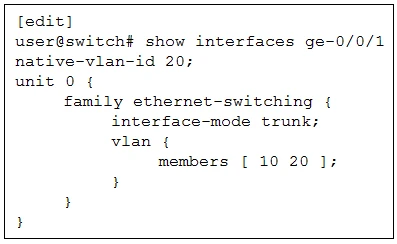
Click the Exhibit button.
Exam JN0-363: Question 9 - Image 1
Referring to the exhibit, what will happen to untagged frames?
Answer

Suggested Answer

The suggested answer is D.

The interface configuration includes the command 'native-vlan-id 20', which indicates that untagged frames received on this interface will be associated with VLAN 20. In a trunk configuration, the native VLAN is used to handle untagged traffic.

Community Votes2 votes
DSuggested
100%
Question 10 of 94

An OSPF router does not have a router ID configured.
In this scenario, which statement is correct about the router ID?
Answer

Suggested Answer

The suggested answer is B.

In OSPF configuration on Junos OS, if a router ID is not explicitly configured, the router will use the IP address assigned to the loopback interface as the router ID. If there is no loopback interface configured, then the highest IP address assigned to any active physical interface will be used.

Community Votes1 vote
BSuggested
100%