Question 6 of 806

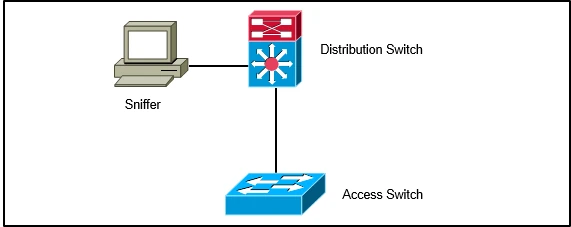
Refer to the exhibit.
Exam 300-115: Question 6 - Image 1
A network engineer wants to analyze all incoming and outgoing packets for an interface that is connected to an access switch. Which three items must be configured to mirror traffic to a packet sniffer that is connected to the distribution switch? (Choose three.)
Answer

Suggested Answer

The suggested answer is B, C, D.

You can analyze network traffic passing through ports or VLANs by using SPAN or RSPAN to send a copy of the traffic to another port on the switch or on another switch that has been connected to a network analyzer or other monitoring or security device. SPAN copies (or mirrors) traffic received or sent (or both) on source ports or source VLANs to a destination port for analysis.
RSPAN supports source ports, source VLANs, and destination ports on different switches (or different switch stacks), enabling remote monitoring of multiple switches across your network. The traffic for each RSPAN session is carried over a user-specified RSPAN VLAN that is dedicated for that RSPAN session in all participating switches. The RSPAN traffic from the source ports or VLANs is copied into the RSPAN VLAN and forwarded over trunk ports carrying the RSPAN
VLAN to a destination session monitoring the RSPAN VLAN. Each RSPAN source switch must have either ports or VLANs as RSPAN sources. The destination is always a physical port.
Reference: http://www.cisco.com/c/en/us/td/docs/switches/lan/catalyst3750x_3560x/software/release/12-2_55_se/configuration/guide/3750xscg/swspan.html
Question 7 of 806

After an EtherChannel is configured between two Cisco switches, interface port channel 1 is in the down/down state. Switch A is configured with channel-group 1 mode active, while Switch B is configured with channel-group 1 mode desirable. Why is the EtherChannel bundle not working?
Answer

Suggested Answer

The suggested answer is A.

Here we have a situation where one switch is using active mode, which is an LACP mode, and the other is using desirable, which is a PAGP mode. You can not mix the LACP and PAGP protocols to form an etherchannel. Here is a summary of the various etherchannel modes:
Exam 300-115: Question 7 - Image 1
Reference: http://www.cisco.com/c/en/us/td/docs/switches/lan/catalyst2960/software/release/12-2_55_se/configuration/guide/scg_2960/swethchl.html A
Question 8 of 806

An EtherChannel bundle has been established between a Cisco switch and a corporate web server. The network administrator noticed that only one of the
EtherChannel links is being utilized to reach the web server. What should be done on the Cisco switch to allow for better EtherChannel utilization to the corporate web server?
Answer

Suggested Answer

The suggested answer is E.

EtherChannel load balancing can use MAC addresses, IP addresses, or Layer 4 port numbers, and either source mode, destination mode, or both. The mode you select applies to all EtherChannels that you configure on the switch. Use the option that provides the greatest variety in your configuration. For example, if the traffic on a channel only goes to a single MAC address (which is the case in this example, since all traffic is going to the same web server), use of the destination
MAC address results in the choice of the same link in the channel each time. Use of source addresses or IP addresses can result in a better load balance.
Reference: http://www.cisco.com/c/en/us/support/docs/lan-switching/etherchannel/12023-4.html
Question 9 of 806

Interface FastEthernet0/1 is configured as a trunk interface that allows all VLANs. This command is configured globally: monitor session 2 filter vlan 1 8, 39, 52
What is the result of the implemented command?
Answer

Suggested Answer

The suggested answer is E.

The "monitor session filter" command is used to specify which VLANS are to be port mirrored using SPAN. This example shows how to monitor VLANs 1 through 5 and VLAN 9 when the SPAN source is a trunk interface:
Switch(config)# monitor session 2 filter vlan 1 5 , 9
Reference: http://www.cisco.com/c/en/us/td/docs/switches/lan/catalyst4500/12-2/25ew/configuration/guide/conf/span.html/index.html#wp1066836
Question 10 of 806

A network engineer notices inconsistent Cisco Discovery Protocol neighbors according to the diagram that is provided. The engineer notices only a single neighbor that uses Cisco Discovery Protocol, but it has several routing neighbor relationships. What would cause the output to show only the single neighbor?
Answer

Suggested Answer

The suggested answer is A.

If all of the routers are connected to each other using a layer 2 switch, then each router will only have the single switch port that it connects to as its neighbor.
Even though multiple routing neighbors can be formed over a layer 2 network, only the physical port that it connects to will be seen as a CDP neighbor. CDP can be used to determine the physical topology, but not necessarily the logical topology.