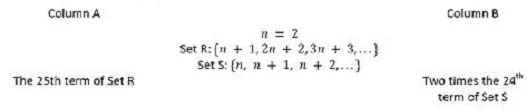

Question 6 of 424

Exam GRE Section 2 Quantitative: Question 6 - Image 1
Answer

Suggested Answer

The suggested answer is A.

Given n= 2, the 25th term of Set R = 25n+ 25 = 25(2) + 25 = 75. Given n= 2, the 24th term of Set S =n+ 23 = 2 + 23 = 25, and two times that 24th term is 50.
Question 7 of 424

Exam GRE Section 2 Quantitative: Question 7 - Image 1
Answer

Suggested Answer

The suggested answer is C.

Theres no need to calculate either quantity, and you can cancel the products from both columns. To make the comparison, observe the place-value shifts from the decimal number 9.3. In Column A, the decimal point shifts 3 places left (9,300) and 3 places right (.0093), so the quantity is equivalent to (9.3) (9.3). You can now see that Quantity B, which is (9.3)(9.3), is the same as Quantity A.
Question 8 of 424

A farmer wants to fence a rectangular horse corral with an area of 12,000 square feet. Fence posts along each side will be 10 feet apart at their center.


Exam GRE Section 2 Quantitative: Question 8 - Image 1
Answer

Suggested Answer

The suggested answer is B.

Theres no need to calculate either quantity. Given an area of 12,000 square feet, the shortest possible rectangular perimeter is achieved with a square, in which all sides are the same length. Column B describes a corral with a width of 300 feet and a length of 400 feet. This corral would require more fence posts than a square corral.
Question 9 of 424

Exam GRE Section 2 Quantitative: Question 9 - Image 1
Answer

Suggested Answer

The suggested answer is B.

You can make the comparison quickly by recognizing that Quantity A is the
Exam GRE Section 2 Quantitative: Question 9 - Image 2
"difference of two squares" (
) in the factored form (x + y) (x -y), where y= 2. Or, you can multiply the two binomials in Column A, and then simplify:
Exam GRE Section 2 Quantitative: Question 9 - Image 3
Quantity A <Quantity B. B
Question 10 of 424

Exam GRE Section 2 Quantitative: Question 10 - Image 1
Answer

Suggested Answer

The suggested answer is A.

Q percent is based on $100. Therefore, Q percent = Q dollars, and Quantity B will always be $1 less than Quantity A.
