Question 6 of 129

Which one of the platform module functions should be used to determine the underlying platform name?
Answer

Suggested Answer

The suggested answer is D.

The function platform.platform() should be used to determine the underlying platform name. This function returns a single string identifying the underlying platform with as much useful information as possible, which typically includes the system, release, and version.

Community Votes7 votes
DSuggested
100%
Question 7 of 129

What is the expected behavior of the following code?
Exam PCAP-31-03: Question 7 - Image 1
Answer

Suggested Answer

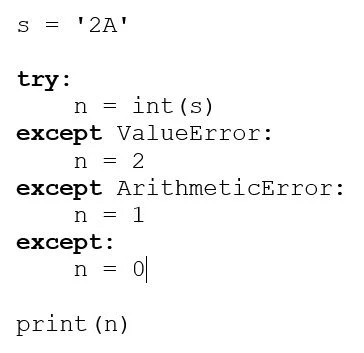
The suggested answer is C.

The code attempts to convert the string '2A' to an integer using int(s). Since '2A' is not a valid integer, this raises a ValueError exception. The ValueError except block is executed, which sets n to 2. None of the other exception blocks are executed, and the value of n (which is 2) is printed. Therefore, the expected behavior of the code is that it outputs 2.

Community Votes3 votes
CSuggested
100%
Question 8 of 129

Which of the following snippets will execute without raising any unhandled exceptions? (Choose two.)
Answer

Suggested Answer

The suggested answer is A, B.

The correct snippets that will execute without raising any unhandled exceptions are the ones that handle all potential errors through appropriate exception handling. By examining each snippet, A and B meet this criterion. Thus, they will execute without causing any unhandled exceptions.

Community Votes7 votes
ABSuggested
100%
Question 9 of 129

What is the expected behavior of the following code?
Exam PCAP-31-03: Question 9 - Image 1
Answer

Suggested Answer

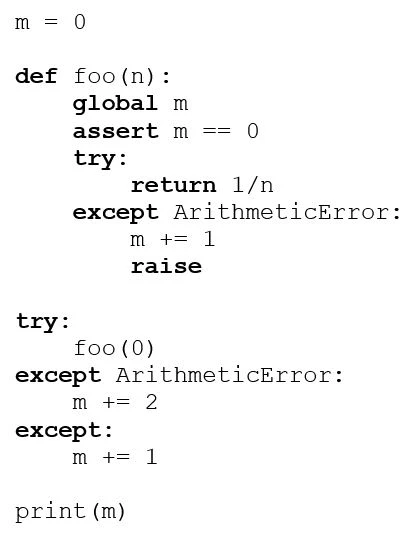
The suggested answer is A.

The code initializes the variable m to 0. The function foo is defined to take an argument n. Inside foo, it is asserted that m is 0. The function then tries to return the result of 1 divided by n. When foo(0) is called, a ZeroDivisionError occurs as division by zero is not allowed. The catch block for ArithmeticError increments m by 1 and re-raises the exception. The outer try-except block catches the ArithmeticError, increments m by 2, and does not re-raise the exception. A generic exception block is present but will not be executed. Therefore, m is incremented first by 1 in the inner except block and then by 2 in the outer except block, resulting in m being 3 at the end of the execution. Hence, the output of the code is 3.
Community Votes1 vote
ASuggested
100%
Question 10 of 129

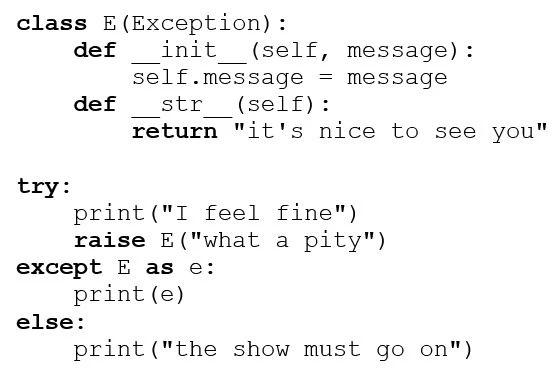
What is true about the following snippet? (Choose two.)
Exam PCAP-31-03: Question 10 - Image 1
Answer

Suggested Answer

The suggested answer is B, D.

The given code snippet first executes the `print(

Community Votes6 votes
BDSuggested
83%
AB
17%