Question 6 of 65

Click the Exhibit button.

[edit] [edit]

lab@r1# show protocols lab@r2# show protocolsospf3 { ospf3 {area 0.0.0.0 { area 0.0.0.0 {interface 1o0.0; interface 1o0.0;interface ge-1/0/6.0; interface ge-1/0/7.0;}}lo0 = 172.16.100.1/32 [edit]fc00:1000::1/128 lab@r2# show protocolsospf3 {area 0.0.0.0 {interface 1o0.0;interface ge-1/1/7.0;interface ge-1/1/6.0;}}

You must ensure that r1's IPv4 loopback address exists in r3's inet 0 routing table.

Referring to the exhibit, which statement is true?

Answer

Suggested Answer

The suggested answer is C.

A RIB group is a way to have a routing protocol, in most cases, place information in multiple route tables.
Each RIB group is named and told where to place and retrieve route information. An example of a RIB group is: routing-options { rib-groups { test { import-rib [ inet.0 test.inet.0 ];
}
}
References:
https://kb.juniper.net/InfoCenter/index?page=content&id=kb16133&actp=search
Question 7 of 65

Click the Exhibit button.

Exam JN0-661: Question 7 - Image 1

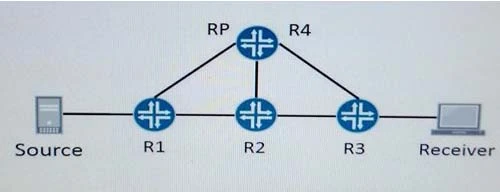
Referring to the exhibit, you have a network that uses PIM-SM and you need to block certain PIM register messages.

Which two statements are correct in this situation? (Choose two.)

Answer

Suggested Answer

The suggested answer is A.

You can filter Protocol Independent Multicast (PIM) register messages sent from the designated router (DR) or to the rendezvous point (RP).
Note: In a shared tree, the root of the distribution tree is a router, not a host, and is located somewhere in the core of the network. In the primary sparse mode multicast routing protocol, Protocol Independent Multicast sparse mode (PIM SM), the core router at the root of the shared tree is the rendezvous point (RP).
References:
http://www.juniper.net/documentation/en_US/junos15.1/topics/example/ospf-designated-router-election-configuring.html
Question 8 of 65

Which statements are true about NG MVPNs? (Choose two.)

Answer

Suggested Answer

The suggested answer is B, D.

Inter-AS MVPN Membership Discovery (Type 2 Routes), via BGP MCAST-VPN address family, are used for membership discovery between PE routers that belong to different autonomous systems (ASs).
The service provider uses RSVP-TE point-to-multipoint LSPs for transmitting VPN multicast data across the network.
References: Technology Overview, Understanding Junos OS Next-Generation Multicast VPN, pages 2, 8 https://www.juniper.net/techpubs/en_US/release-independent/nce/information-products/topic-collections/nce/nce0090-ng-mvpn-understanding/ng-mvpn- understanding.pdf
Question 9 of 65

A service provider wants to start using all of their LSPs for internal traffic and not just their MPLS VPNs. Any solution must ensure that existing VPNs and routing policies will continue to function properly.

Which MPLS traffic engineering parameter would accomplish this task?

Answer

Suggested Answer

The suggested answer is B.

Using LSPs for Forwarding in Virtual Private Networks
VPNs require that routes remain in the inet.3 routing table to function properly. For VPNs, configure the bgp-igp-both-ribs option of the traffic-engineering statement to cause BGP and the IGPs to use LSPs for forwarding traffic destined for egress routers.
Incorrect Answers:
C: You can configure BGP and the IGPs to use LSPs for forwarding traffic destined for egress routers by including the bgp-igp option for the traffic-engineering statement.
References:
https://www.juniper.net/documentation/en_US/junos15.1/topics/usage-guidelines/mpls-configuring-traffic-engineering-for-lsps.html
Question 10 of 65

Click the Exhibit button.

user@router# run show route 2.0.0.0/8inet.0: 101 destinations, 198 routes (100active, 0 holddown, 1 hidden)+ = Active Route, - = Last Active, * = Both2.0.0.0/8 *[BGP/170] 00: 12:06, MED1000, Localpref 100, from 10.220.1.2As path: 2000 I,validation-state: unverified> to 10.220.15.2 via ge-1/0/0.0, label-switched-path r1-to-r3to 10.220.12.2 via ge-1/1/0.0, label-switched-path r1-to-r3[BGP/170] 00 10, MED1000, localpref 100, from 10.220.1.5AS path: 2000 I,validation-state: unverified> to 10.220.15.2 via ge-1/0/0.0, label-switched-path r1-to-r3to 10.220.12.2 via ge-1/1/0.0, label-switched-path r1-to-r32.6.6.6/32 *[BGP/170] 00:12:06, MED1000, localpref 100, from 10.220.1.2AS path: 2000 I,validation-state: unverified> to 10.220.15.2 via ge-1/0/0.0, label-switched-path r1-tor3to 10.220.12.2 via ge-1/1/0.0, label-switched-path r1-to-r3[BGP/170] 00:12:10, MED1000, localpref 100, from 10.220.1.5AS path: 2000 I,validation-state: unverified> to 10.220.15.2 via ge-1/0/0.0, label-switched-path r1-to-r3to 10.220.12.2 via ge-1/1/0.0, label-switched-path r1-to-r3user@router# run show route advertising-protocolbgp 192.168.11.0inet.0: 101 destinations, 198 routes (100active, 0 holddown, 1 hidden)Prefix NexthopMED Lclpref AS path* 2.6.6.6/32 Self2000 I[edit protocols bgp]user@router# showexport reject;group peer {export as1000;neighbor 192.168.11.0 {family inet {unicast;}peer-as 1000;}}[edit policy-options]user@router# showpolicy-statement as1000 {term 1 {from {route-filter 2.0.0.0/8 longer;}then accept;}term 2 {then reject;}}policy-statement reject {term 1 {from {route-filter 2.0.0.0/8 exact;}then reject}}You want to advertise routes 2.0.0.0/8 and 2.6.6.6/32 to BGP peer 192.168.11.0.Referring to the exhibit, which configuration change would satisfy this requirement?
Answer

Suggested Answer

The suggested answer is B.

We must change the match type from longer to orlonger in the as1000 policy. The match type Orlonger matches if the prefix-length is equal to or greater than the routes prefix length, while the Longer match type only matches if the prefix-length is greater than the routes prefix length.
References:
http://www.juniper.net/documentation/en_US/junos15.1/topics/example/policy-prefix-list.html