Question 6 of 60

An administrator wants to exclude Request level logging details from being captured.

Which logging level must be set?

Answer

Suggested Answer

The suggested answer is A.

The higher you set the logging level, the more it degrades system performance. Normally, you set the level to Minimal or Basic to collect errors, or to Request to collect errors and warnings.
Note: Report validation levels and logging levels
✑ Report validation level, Logging level
✑ Error: Minimal, Basic
✑ Warning: Request
✑ Key Transformation: Trace
✑ Information: Full
References:
https://www.ibm.com/support/knowledgecenter/en/SSEP7J_11.0.0/com.ibm.swg.ba.cognos.ug_cra.doc/c_logginglevels.html
Question 7 of 60

An administrator wants to ensure that a datasource can be referenced when creating data modules in the IBM Cognos Analytics Portal (New > Data module).

What must be done to accomplish this?

Answer

Suggested Answer

The suggested answer is D.

Problem(Abstract): Datasource connections not listed in Data server by default
Symptom: We can see the datasource in the Admin console but not in the list of data servers.
Cause: This is default behavior.

Resolving the problem -
Go to the Administrative Console -> Configuration -> Set properties -> Connections tab.
On the bottom, you will see "Data source capabilities"
Inside that, check the box which says "Allow web-based modeling"
Once you check this, the datasource would be present as data server.
References:
http://www-01.ibm.com/support/docview.wss?uid=swg21978718
Question 8 of 60

An administrator wants to render a report and ensure the completed HTML is sent back to the gateway.

Which service is responsible for the rendering task?

Answer

Suggested Answer

The suggested answer is C.

The Presentation service -
✑ Transforms generic XML responses from another service into output format, such as HTML or PDF
✑ Provides display, navigation, and administration capabilities in IBM Cognos Connection
Incorrect Answers:
A: The Report service manages interactive requests to run reports and provides output for a user in IBM Cognos Connection or a studio.
B: The Delivery service sends emails to an external SMTP server on behalf of other services, such as the report service, job service, agent service, or data integration service
D: The Content Manager service:
✑ Performs object manipulation functions in the content store, such as add, query, update, delete, move, and copy
✑ Performs content store management functions, such as import and export
References: IBM Cognos Administration Version 10.1.0, Administration and Security Guide, page 139
Question 9 of 60

An environment has the following routing rules set:
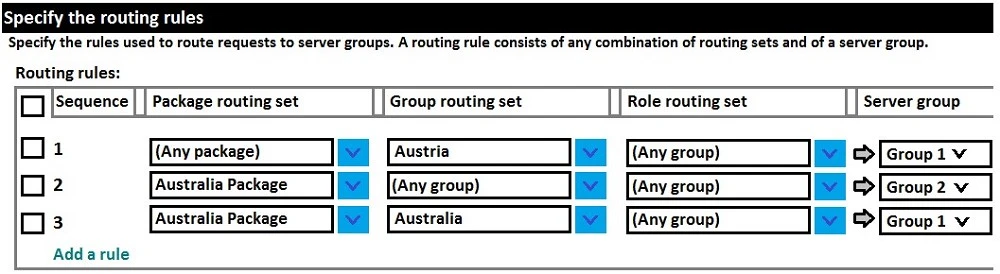
Exam C2090-623: Question 9 - Image 1

If a report using the Australia Package is run by a user belonging to Australia Group, which server group will the request be sent to?

Answer

Suggested Answer

The suggested answer is B.

Unlike routing keywords, the order in which the routing rules are listed affects how they are applied.
A rule is matched when properties associated with the package or the group or role involved in the request satisfy the criteria of the rule. The rules are evaluated in order until the first one is matched, and the request is routed to the server group named by the first rule that was matched. You can change the order of the rules by clicking Modify the sequence.
References:
https://www.ibm.com/support/knowledgecenter/en/SSEP7J_10.2.2/com.ibm.swg.ba.cognos.ug_cra.10.2.2.doc/ t_asg_set_routing_keywords_server.html
Question 10 of 60

All users have unrestricted access in a secured environment.

What must be modified to control this access?

Answer

Suggested Answer

The suggested answer is B.

You can disable the Anonymous user account by changing the configuration parameters in the configuration tool.
This entry represents a user account shared by members of the general public who can access IBM Cognos software without being prompted for authentication.
For example, this type of access is useful when distributing an online catalog.
Anonymous users can see only those entries for which access permissions are not set, or are set specifically for this account or for the Everyone group.
Incorrect Answers:
A: The built-in entries include the Anonymous user account, the groups All Authenticated Users and Everyone, and the role System Administrators. You cannot delete the built-in entries. They appear in both secured and non-secured environments.
References: IBM Cognos Administration Version 10.1.0, Administration and Security Guide, page 297