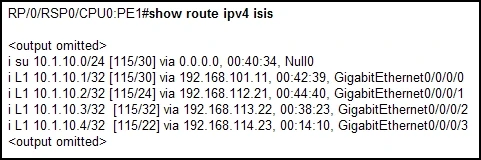
The suggested answer is A, C, E, F.
http://www.cisco.com/en/US/docs/ios_xr_sw/iosxr_r3.0/routing/configuration/guide/rc3isis.html#wp1148617
Single-Topology IPv6 Support -
Single-topology IPv6 support on Cisco IOS XR software allows IS-IS for IPv6 to be configured on interfaces along with an IPv4 network protocol. All interfaces must be configured with the identical set of network protocols and all routers in the IS-IS area (for Level 1 routing) or the domain (for Level 2 routing) must support the identical set of network layer protocols on allinterfaces.
When single-topology support for IPv6 is used, only narrow link metrics, also known as old-style type, length, value (TLV) arguments, may be employed. During single-topology operation, one shortest path first (SPF) computation per level is used to compute both IPv4 and IPv6 routes. Using a single SPF is possible because both IPv4 IS-IS and IPv6 IS-IS routing protocols share a common link topology.
Because multitopology is the default behavior in the software, you must explicitly configure IPv6to use the same topology as IPv4 in order to enable single- topology IPv6. Configure the single-topology command in ipv6 address family configuration submode of the IS-IS router stanza.
Multitopology IPv6 Support -
Multitopology IPv6 support on Cisco IOS XRsoftware differs from Cisco IOS software in that IS-IS assumes that multitopology support is required as soon as it detects interfaces configured for both IPv6 and IPv4 within the IS-IS stanza.
You must use the metric-style wide command to configure IS-ISto wide link metrics as multitopology link advertisements.