Question 6 of 126

Which IP addresses are matched by the permit 192.168.80.64 0.0.0.15 access-list entry?
Answer

Suggested Answer

The suggested answer is E.

Question 7 of 126

Which two statements about NAT444 are true? (Choose two.)
Answer

Suggested Answer

The suggested answer is B, E.

Carrier-grade NAT (CGN), also known as large-scale NAT (LSN), is an approach to IPv4 network design in which end sites, in particular residential networks, are configured with private network addresses that are translated to public IPv4 addresses by middlebox network address translator devices embedded in the network operator's network, permitting the sharing of small pools of public addresses among many end sites. This shifts the NAT function and configuration thereof from the customer premises to the Internet service provider network.
Carrier-grade NAT has been proposed as an approach for mitigating IPv4 address exhaustion.[1]
Critics of carrier-grade NAT argue the following aspects:
Like any form of NAT, it breaks the end-to-end principle.[2]
It has significant security, scalability, and reliability problems, by virtue of being stateful.
It makes record keeping for law-enforcement operations more difficult.
It makes it impossible to host services on well known ports.
It does not solve the IPv4 address exhaustion problem when a routable IP address is needed, such as in web hosting.
One use scenario of CGN can be described as NAT444,[3] because some customer's connections to public servers would pass through three different IPv4 addressing domains: the customer's own private network, the carrier's private network, and the public Internet.
Another CGN scenario is Dual-Stack Lite, in which the carrier's network uses IPv6 and thus only two IPv4 addressing domains are needed.
Question 8 of 126

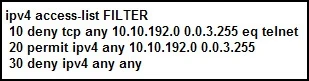
Refer to the exhibit.
Exam 640-878: Question 8 - Image 1

The access list has been configured on the Gi0/0/0/0 interface in the inbound direction. Which four packets that are sourced from 10.1.1.1 TCP port 1060, if they are routed to the Gi0/0/0/0 interface, will be permitted? (Choose four)
Answer

Suggested Answer

The suggested answer is C, D, E, F.

Question 9 of 126

Which two statements about NAT64 are true? (Choose two.)
Answer

Suggested Answer

The suggested answer is C, E.

http://www.cisco.com/en/US/prod/collateral/iosswrel/ps6537/ps6553/white_paper_c11-676278.html
All viable translation scenarios are supported by NAT64, and therefore NAT64 is becoming the most sought translation technology. AFT using NAT64 technology can be achieved by either stateless or stateful means:
Stateless NAT64, defined in RFC 6145, is a translation mechanism for algorithmically mapping IPv6 addresses to IPv4 addresses, and IPv4 addresses to IPv6 addresses. Like NAT44, it does not maintain any bindings or session state while performing translation, and it supports both IPv6-initiated and IPv4-initiated communications.
Stateful NAT64, defined in RFC 6146, is a stateful translation mechanism for translating IPv6 addresses to IPv4 addresses, and IPv4 addresses to IPv6 addresses. Like NAT44, it is called stateful because it creates or modifies bindings or session state while performing translation. It supports both IPv6-initiated and
IPv4-initiated communications using static or manual mappings.
DNS64, an optional component defined in RFC 6147, when used in conjunction with NAT64, would trick the IPv6 hosts into thinking that the IPv4 destination as an
IPv6 address, by synthesizing AAAA (quad A) resource records from A resource records.
Question 10 of 126

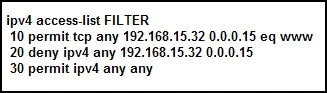
Refer to the exhibit.
Exam 640-878: Question 10 - Image 1

The access list has been configured on the Gi0/0/0/0 interface in the inbound direction. Which two packets that are sourced from 172.16.1.1 TCP port 1050, if they are routed to the Gi0/0/0/0 interface, will be permitted? (Choose two)
Answer

Suggested Answer

The suggested answer is A, B.