Question 6 of 1066

DRAG DROP -
Drag and drop the characteristics from the left onto the appropriate infrastructure deployment types on the right.
Select and Place:
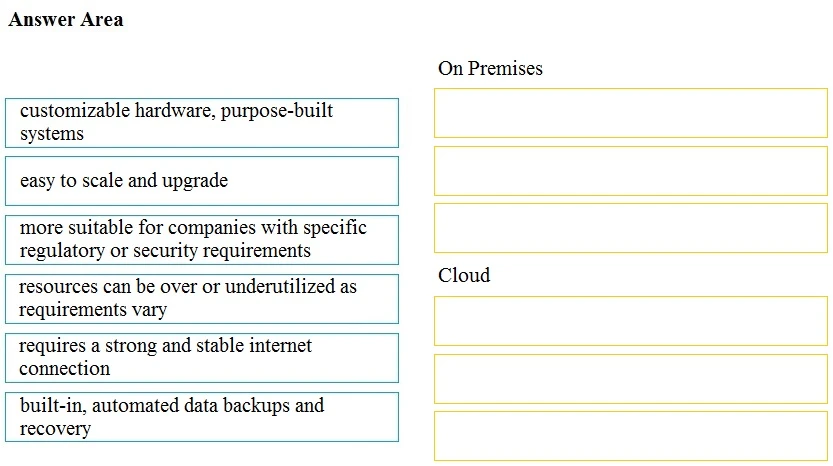
Exam 350-401: Question 6 - Image 1
Answer

Suggested Answer

Exam 350-401: Question 6 - Image 2
Question 7 of 1066

How does QoS traffic shaping alleviate network congestion?
Answer

Suggested Answer

The suggested answer is B.

QoS traffic shaping alleviates network congestion by buffering and queuing packets that exceed the committed rate. This helps smooth out bursts in traffic, allowing for more consistent data flow and preventing packet loss. Traffic shaping ensures that packets are held in a queue and sent out in a controlled manner when the network has the capacity to handle them. This is different from traffic policing, which would drop packets that exceed a certain bitrate, and other mechanisms such as packet fragmentation or random packet dropping from lower priority queues.

Community Votes5 votes
BSuggested
100%
Question 8 of 1066

An engineer is describing QoS to a client.
Which two facts apply to traffic policing? (Choose two.)
Answer

Suggested Answer

The suggested answer is A, D.

Traffic policing involves monitoring the data rate of a traffic flow and taking action when the rate exceeds the defined threshold. This action often includes dropping packets, thus policing drops traffic that exceeds the defined rate. Additionally, it is most effective and efficient to perform policing as close to the traffic source as possible in order to prevent excessive traffic from entering the network core and to manage bandwidth more effectively.

Community Votes8 votes
ADSuggested
88%
CD
13%
Question 9 of 1066

Which component handles the orchestration plane of the Cisco SD-WAN?
Answer

Suggested Answer

The suggested answer is A.

The component that handles the orchestration plane of the Cisco SD-WAN is vBond. vBond is responsible for authenticating the vSmart controllers and the SD-WAN routers, orchestrating connectivity between them. It is designed to be the first point of contact for SD-WAN devices and facilitates mutual discovery and initial authentication. Therefore, vBond is the correct answer.

Community Votes11 votes
ASuggested
100%
Question 10 of 1066

What are two device roles in Cisco SD-Access fabric? (Choose two.)
Answer

Suggested Answer

The suggested answer is A, E.

In Cisco SD-Access fabric, the Edge Node is a device that connects endpoints to the fabric network and serves as the entry point for user traffic. The Border Node is responsible for connecting the SD-Access fabric to external networks and handling traffic entering and leaving the fabric. These roles are crucial for the proper functioning and management of the SD-Access environment.

Community Votes6 votes
AESuggested
100%