(e.g., which rack/port to connect).
What is the AWS-recommended procedure for providing this information?
The ELB is configured to use round robin, and sticky sessions are disabled. You have configured the NACLs and security groups to allow port 22 from your bastion host, and port 80 from 0.0.0.0/0. The client configuration is managed by each regional IT team.
Upon inspection you find that a large amount of requests from incorrectly configured sites are causing a single application server to degrade. The remainder of the requests are equally distributed across all servers with no negative effects.
What should you do to remedy the situation and prevent future occurrences?
According to the organization's security team, the VPN must meet the following requirements:
✑ AES 128-bit encryption
✑ SHA-1 hashing
✑ User access via SSL VPN
✑ PFS using DH Group 2
✑ Ability to maintain/rotate keys and passwords
✑ Certificate-based authentication
Which solution should you recommend so that the organization meets the requirements?
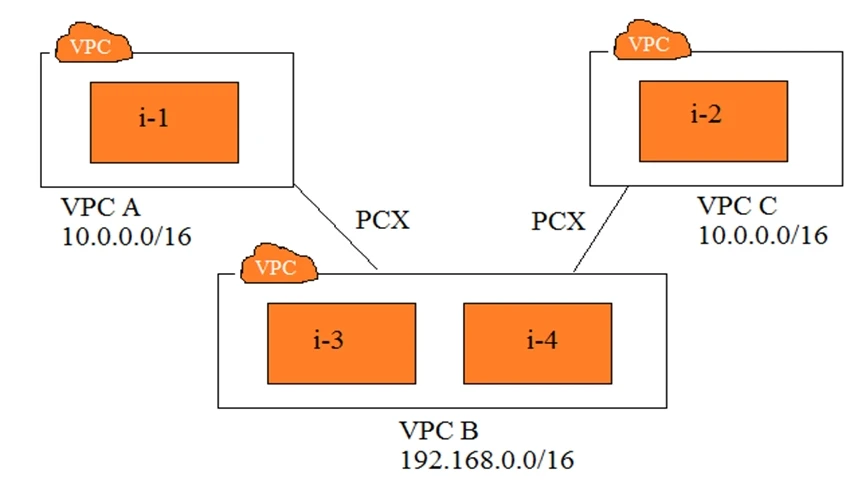
You have three VPCs: A, B, and C. VPCs A and C are both peered with VPC B. The IP address ranges are as follows:
✑ VPC A: 10.0.0.0/16
✑ VPC B: 192.168.0.0/16
✑ VPC C: 10.0.0.0/16
Instance i-1 in VPC A has the IP address 10.0.0.10. Instance i-2 in VPC C has the IP address 10.0.0.10. Instances i-3 and i-4 in VPC B have the IP addresses
192.168.1.10 and 192.168.1.20, respectively, i-3 and i-4 are in the subnet 192.168.1.0/24.
✑ i-3 must be able to communicate with i-1
✑ i-4 must be able to communicate with i-2
✑ i-3 and i-4 are able to communicate with i-1, but not with i-2.
Which two steps will fix this problem? (Choose two.)