An organization map highlights where in the organization that stakeholder concerns are not being addressed by a business architecture. An organization chart, on the other hand, generally depicts the formal structure of an organization, showing the roles and hierarchical relationships. The organization map serves to identify gaps and areas needing attention, which is a key difference from the static representation provided by an organization chart.
Community votes
No votes yet
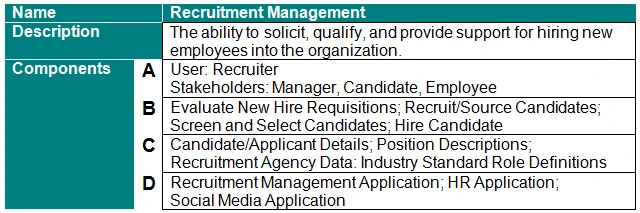
Which of the following are A and C?
Recruitment Management involves both roles and information. Components related to roles include 'User: Recruiter' and 'Stakeholders: Manager, Candidate, Employee.' Components related to information include 'Candidate/Applicant Details,' 'Position Descriptions,' 'Recruitment Agency Data,' and 'Industry Standard Role Definitions.' Therefore, the correct answer is 'Roles, Information.'
Community votes
No votes yet
A TOGAF business scenario is best described as a technique to elaborate an architecture effort. It involves understanding and documenting key elements in order to validate, elaborate, and potentially modify the premises of an architecture project. This makes it clear that the correct answer is a technique to elaborate an architecture effort.
Community votes
No votes yet
In Phase A a business capability map and a core set of value streams were created while developing the Architecture Vision.
Why would such Architecture Descriptions need to be updated in Phase B?
The Architecture Descriptions need to be updated in Phase B because a new value stream was assessed as being in the project scope. This would necessitate revisiting and potentially modifying the original business capability map and core set of value streams created during Phase A to ensure they align with this new value stream and its requirements.
Community votes
No votes yet
Risk is defined as the effect of uncertainty on objectives. This definition encapsulates how uncertain events or lack of knowledge may influence the achievement of an organization’s goals.
Community votes
No votes yet