Word 2016: Core Document Creation, Collaboration and Communication

Here you have the best Microsoft 77-725 practice exam questions

  • You have 34 total questions across 7 pages (5 per page)
  • These questions were last updated on February 17, 2026
  • This site is not affiliated with or endorsed by Microsoft.
Question 1 of 34

SIMULATION -

Project 1 of 7: Observation -

Overview -
You are a member of the Barstow College Observation Project committee. You are preparing the initial summary report for this year's count, but have not received all of the data you need to complete the report.

Exam 77-725: Question 1 - Image 1

Introduction -
The multi-departmental Wildlife Observation Project has completed its wildlife population counts for this year. The counts were made between May 5 and May 7 for both the wilderness and cultivated land areas. This is in line with the count periods for all previous years. The species used for the counts have been identified as common for the region (central Missouri) in which the counts were taken. (Author, 2009)
As in previous years, five observation blinds were set up two weeks before the counts were to take place. Counters worked eight-hour shifts providing 24-hour coverage of the count areas for two days. Weather for both observation days was clear and mild (varying between 50-70 degrees F).
The results presented here are summary total results only, which counts from five and ten years ago provided for comparison. Detailed observation results will be available as soon as they are completed. We estimate that they will be available some time in the next two weeks.

Wilderness Summary -
The wilderness observation area is a five-acre section of unimproved forest land. The most common trees in the area are maple, red oak, cedar, sweet gum, and hickory. The area also includes a small spring. The area is not enclosed by a fence or other man-made barrier.
The area is located eight miles from the nearest paved road and twelve miles from the nearest residence. Off-road vehicles were used to bring counters close to, but not entering, the count area. The nearest approach by off-road vehicles was one mile.
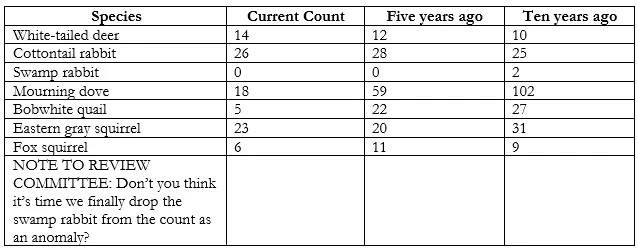
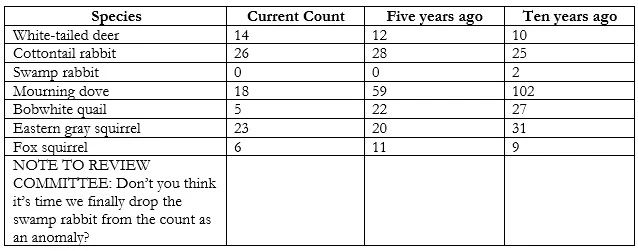
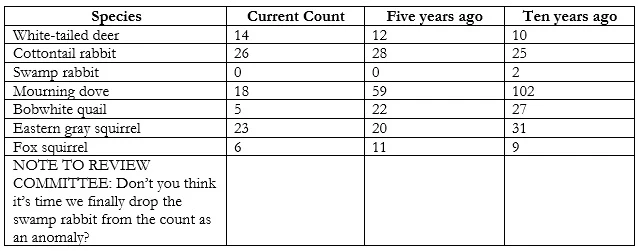
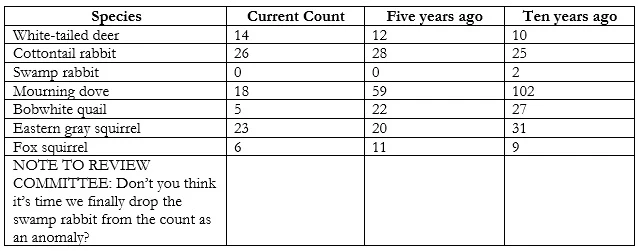
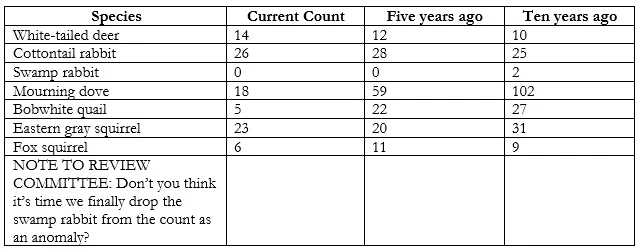
The table below lists the summary counts.
Exam 77-725: Question 1 - Image 2
Though further research any analysis is needed, the drop in mourning dove and bobwhite quail counts could be significant. The detailed count data shows these numbers failing off each year.

Cultivated Land Summary -
The cultivated land observation area is a five-acre section of cultivated land near the center of a 50-acre field. The field is used to grow corn, wheat, soybeans, and clover, with the crop rotated annually. In the fifth year of the cycle, the field is left fallow.
The area is located two miles from the nearest paved road and one mile from the nearest residence. A storage barn is located at the southern border of the field.
The table below lists the summary counts.

Additional Notes -
This project was initially scheduled to run for ten years, so we are currently in our last year. The committee needs to decide if it is worth the time and expense to continue the project. The landowners have experience that they would be happy to let us continue. Costs relating to the project is minimal and it does provide an opportunity to offer extra credit to students volunteering as counters.
A suggestion has been made by some committee members that we should increase the count frequency, counting on a quarterly schedule instead of an annual schedule. This would need to be coordinated with the owner of the cultivated field so that we do not interfere with planting or harvesting schedules.

Special Thanks -
Once again, we would like to offer special thanks to:
We couldn't do this without you.
Add a SmartArt Vertical Bullet List below the text "Once again, we would like to offer special thanks to: ". Add the text "Frank Miller" to the top green shape.

Answer

Suggested Answer

Question 2 of 34

SIMULATION -

Project 1 of 7: Observation -

Overview -
You are a member of the Barstow College Observation Project committee. You are preparing the initial summary report for this year's count, but have not received all of the data you need to complete the report.
Exam 77-725: Question 2 - Image 1

Introduction -
The multi-departmental Wildlife Observation Project has completed its wildlife population counts for this year. The counts were made between May 5 and May 7 for both the wilderness and cultivated land areas. This is in line with the count periods for all previous years. The species used for the counts have been identified as common for the region (central Missouri) in which the counts were taken. (Author, 2009)
As in previous years, five observation blinds were set up two weeks before the counts were to take place. Counters worked eight-hour shifts providing 24-hour coverage of the count areas for two days. Weather for both observation days was clear and mild (varying between 50-70 degrees F).
The results presented here are summary total results only, which counts from five and ten years ago provided for comparison. Detailed observation results will be available as soon as they are completed. We estimate that they will be available some time in the next two weeks.

Wilderness Summary -
The wilderness observation area is a five-acre section of unimproved forest land. The most common trees in the area are maple, red oak, cedar, sweet gum, and hickory. The area also includes a small spring. The area is not enclosed by a fence or other man-made barrier.
The area is located eight miles from the nearest paved road and twelve miles from the nearest residence. Off-road vehicles were used to bring counters close to, but not entering, the count area. The nearest approach by off-road vehicles was one mile.
The table below lists the summary counts.
Exam 77-725: Question 2 - Image 2
Though further research any analysis is needed, the drop in mourning dove and bobwhite quail counts could be significant. The detailed count data shows these numbers failing off each year.

Cultivated Land Summary -
The cultivated land observation area is a five-acre section of cultivated land near the center of a 50-acre field. The field is used to grow corn, wheat, soybeans, and clover, with the crop rotated annually. In the fifth year of the cycle, the field is left fallow.
The area is located two miles from the nearest paved road and one mile from the nearest residence. A storage barn is located at the southern border of the field.
The table below lists the summary counts.

Additional Notes -
This project was initially scheduled to run for ten years, so we are currently in our last year. The committee needs to decide if it is worth the time and expense to continue the project. The landowners have experience that they would be happy to let us continue. Costs relating to the project is minimal and it does provide an opportunity to offer extra credit to students volunteering as counters.
A suggestion has been made by some committee members that we should increase the count frequency, counting on a quarterly schedule instead of an annual schedule. This would need to be coordinated with the owner of the cultivated field so that we do not interfere with planting or harvesting schedules.

Special Thanks -
Once again, we would like to offer special thanks to:
We couldn't do this without you.
Add a table with eight rows and four columns in the "Cultivated Land Summary" section, below the text "The table below lists the summary counts."
Answer

Suggested Answer

Question 3 of 34

SIMULATION -

Project 1 of 7: Observation -

Overview -
You are a member of the Barstow College Observation Project committee. You are preparing the initial summary report for this year's count, but have not received all of the data you need to complete the report.
Exam 77-725: Question 3 - Image 1

Introduction -
The multi-departmental Wildlife Observation Project has completed its wildlife population counts for this year. The counts were made between May 5 and May 7 for both the wilderness and cultivated land areas. This is in line with the count periods for all previous years. The species used for the counts have been identified as common for the region (central Missouri) in which the counts were taken. (Author, 2009)
As in previous years, five observation blinds were set up two weeks before the counts were to take place. Counters worked eight-hour shifts providing 24-hour coverage of the count areas for two days. Weather for both observation days was clear and mild (varying between 50-70 degrees F).
The results presented here are summary total results only, which counts from five and ten years ago provided for comparison. Detailed observation results will be available as soon as they are completed. We estimate that they will be available some time in the next two weeks.

Wilderness Summary -
The wilderness observation area is a five-acre section of unimproved forest land. The most common trees in the area are maple, red oak, cedar, sweet gum, and hickory. The area also includes a small spring. The area is not enclosed by a fence or other man-made barrier.
The area is located eight miles from the nearest paved road and twelve miles from the nearest residence. Off-road vehicles were used to bring counters close to, but not entering, the count area. The nearest approach by off-road vehicles was one mile.
The table below lists the summary counts.
Exam 77-725: Question 3 - Image 2
Though further research any analysis is needed, the drop in mourning dove and bobwhite quail counts could be significant. The detailed count data shows these numbers failing off each year.

Cultivated Land Summary -
The cultivated land observation area is a five-acre section of cultivated land near the center of a 50-acre field. The field is used to grow corn, wheat, soybeans, and clover, with the crop rotated annually. In the fifth year of the cycle, the field is left fallow.
The area is located two miles from the nearest paved road and one mile from the nearest residence. A storage barn is located at the southern border of the field.
The table below lists the summary counts.

Additional Notes -
This project was initially scheduled to run for ten years, so we are currently in our last year. The committee needs to decide if it is worth the time and expense to continue the project. The landowners have experience that they would be happy to let us continue. Costs relating to the project is minimal and it does provide an opportunity to offer extra credit to students volunteering as counters.
A suggestion has been made by some committee members that we should increase the count frequency, counting on a quarterly schedule instead of an annual schedule. This would need to be coordinated with the owner of the cultivated field so that we do not interfere with planting or harvesting schedules.

Special Thanks -
Once again, we would like to offer special thanks to:
We couldn't do this without you.
Merge all cells in the bottom row of the table below the "Wilderness Summary" heading into one cell.
Answer

Suggested Answer

Question 4 of 34

SIMULATION -

Project 1 of 7: Observation -

Overview -
You are a member of the Barstow College Observation Project committee. You are preparing the initial summary report for this year's count, but have not received all of the data you need to complete the report.
Exam 77-725: Question 4 - Image 1

Introduction -
The multi-departmental Wildlife Observation Project has completed its wildlife population counts for this year. The counts were made between May 5 and May 7 for both the wilderness and cultivated land areas. This is in line with the count periods for all previous years. The species used for the counts have been identified as common for the region (central Missouri) in which the counts were taken. (Author, 2009)
As in previous years, five observation blinds were set up two weeks before the counts were to take place. Counters worked eight-hour shifts providing 24-hour coverage of the count areas for two days. Weather for both observation days was clear and mild (varying between 50-70 degrees F).
The results presented here are summary total results only, which counts from five and ten years ago provided for comparison. Detailed observation results will be available as soon as they are completed. We estimate that they will be available some time in the next two weeks.

Wilderness Summary -
The wilderness observation area is a five-acre section of unimproved forest land. The most common trees in the area are maple, red oak, cedar, sweet gum, and hickory. The area also includes a small spring. The area is not enclosed by a fence or other man-made barrier.
The area is located eight miles from the nearest paved road and twelve miles from the nearest residence. Off-road vehicles were used to bring counters close to, but not entering, the count area. The nearest approach by off-road vehicles was one mile.
The table below lists the summary counts.
Exam 77-725: Question 4 - Image 2
Though further research any analysis is needed, the drop in mourning dove and bobwhite quail counts could be significant. The detailed count data shows these numbers failing off each year.

Cultivated Land Summary -
The cultivated land observation area is a five-acre section of cultivated land near the center of a 50-acre field. The field is used to grow corn, wheat, soybeans, and clover, with the crop rotated annually. In the fifth year of the cycle, the field is left fallow.
The area is located two miles from the nearest paved road and one mile from the nearest residence. A storage barn is located at the southern border of the field.
The table below lists the summary counts.

Additional Notes -
This project was initially scheduled to run for ten years, so we are currently in our last year. The committee needs to decide if it is worth the time and expense to continue the project. The landowners have experience that they would be happy to let us continue. Costs relating to the project is minimal and it does provide an opportunity to offer extra credit to students volunteering as counters.
A suggestion has been made by some committee members that we should increase the count frequency, counting on a quarterly schedule instead of an annual schedule. This would need to be coordinated with the owner of the cultivated field so that we do not interfere with planting or harvesting schedules.

Special Thanks -
Once again, we would like to offer special thanks to:
We couldn't do this without you.
In the table below the "Wilderness Summary", adjust the column width so that all columns are the same width.
Answer

Suggested Answer

Question 5 of 34

SIMULATION -

Project 1 of 7: Observation -

Overview -
You are a member of the Barstow College Observation Project committee. You are preparing the initial summary report for this year's count, but have not received all of the data you need to complete the report.
Exam 77-725: Question 5 - Image 1

Introduction -
The multi-departmental Wildlife Observation Project has completed its wildlife population counts for this year. The counts were made between May 5 and May 7 for both the wilderness and cultivated land areas. This is in line with the count periods for all previous years. The species used for the counts have been identified as common for the region (central Missouri) in which the counts were taken. (Author, 2009)
As in previous years, five observation blinds were set up two weeks before the counts were to take place. Counters worked eight-hour shifts providing 24-hour coverage of the count areas for two days. Weather for both observation days was clear and mild (varying between 50-70 degrees F).
The results presented here are summary total results only, which counts from five and ten years ago provided for comparison. Detailed observation results will be available as soon as they are completed. We estimate that they will be available some time in the next two weeks.

Wilderness Summary -
The wilderness observation area is a five-acre section of unimproved forest land. The most common trees in the area are maple, red oak, cedar, sweet gum, and hickory. The area also includes a small spring. The area is not enclosed by a fence or other man-made barrier.
The area is located eight miles from the nearest paved road and twelve miles from the nearest residence. Off-road vehicles were used to bring counters close to, but not entering, the count area. The nearest approach by off-road vehicles was one mile.
The table below lists the summary counts.
Exam 77-725: Question 5 - Image 2
Though further research any analysis is needed, the drop in mourning dove and bobwhite quail counts could be significant. The detailed count data shows these numbers failing off each year.

Cultivated Land Summary -
The cultivated land observation area is a five-acre section of cultivated land near the center of a 50-acre field. The field is used to grow corn, wheat, soybeans, and clover, with the crop rotated annually. In the fifth year of the cycle, the field is left fallow.
The area is located two miles from the nearest paved road and one mile from the nearest residence. A storage barn is located at the southern border of the field.
The table below lists the summary counts.

Additional Notes -
This project was initially scheduled to run for ten years, so we are currently in our last year. The committee needs to decide if it is worth the time and expense to continue the project. The landowners have experience that they would be happy to let us continue. Costs relating to the project is minimal and it does provide an opportunity to offer extra credit to students volunteering as counters.
A suggestion has been made by some committee members that we should increase the count frequency, counting on a quarterly schedule instead of an annual schedule. This would need to be coordinated with the owner of the cultivated field so that we do not interfere with planting or harvesting schedules.

Special Thanks -
Once again, we would like to offer special thanks to:
We couldn't do this without you.
Add a Status of "Requires committee review" to the document properties.
Answer

Suggested Answer

About the Microsoft 77-725 Certification Exam

About the Exam

The Microsoft 77-725 (Word 2016: Core Document Creation, Collaboration and Communication) validates your knowledge and skills. Passing demonstrates proficiency and can boost your career prospects in the field.

How to Prepare

Work through all 34 practice questions across 7 pages. Focus on understanding the reasoning behind each answer rather than memorizing responses to be ready for any variation on the real exam.

Why Practice Exams?

Practice exams help you familiarize yourself with the question format, manage your time, and reduce anxiety on the test day. Our 77-725 questions are regularly updated to reflect the latest exam objectives.