Querying Data with Transact-SQL

Here you have the best Microsoft 70-761 practice exam questions

  • You have 201 total questions across 41 pages (5 per page)
  • These questions were last updated on February 14, 2026
  • This site is not affiliated with or endorsed by Microsoft.
Question 1 of 201

Note: This question is part of a series of questions that present the same scenario. Each question in the series contains a unique solution that might meet the stated goals. Some question sets might have more than one correct solution, while others might not have a correct solution.
After you answer a question in this section. You will NOT be able to return to it. As a result, these questions will not appear in the review screen.
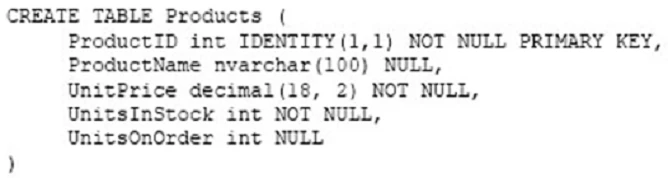
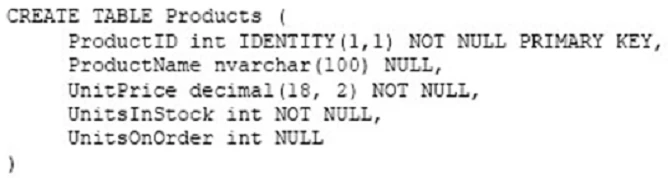
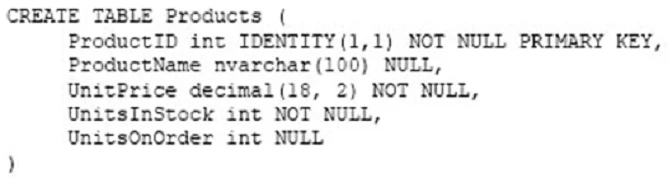
You create a table named Products by running the following Transact-SQL statement:
Exam 70-761: Question 1 - Image 1
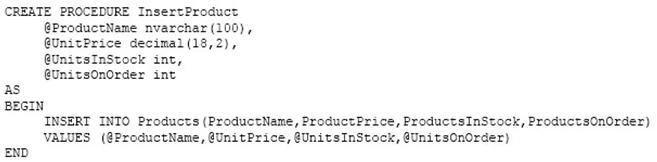
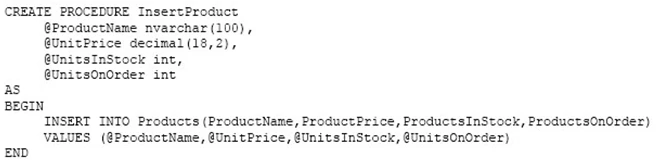
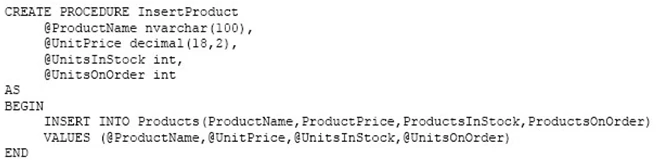
You have the following stored procedure:
Exam 70-761: Question 1 - Image 2
You need to modify the stored procedure to meet the following new requirements:
✑ Insert product records as a single unit of work.
✑ Return error number 51000 when a product fails to insert into the database.
✑ If a product record insert operation fails, the product information must not be permanently written to the database.
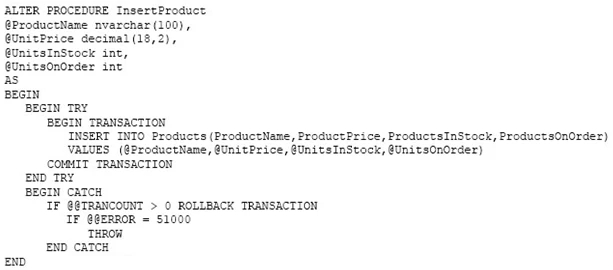
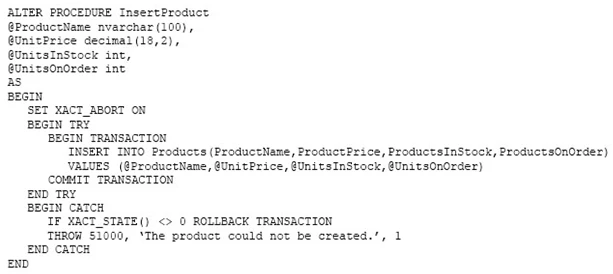
Solution: You run the following Transact-SQL statement:
Exam 70-761: Question 1 - Image 3
Does the solution meet the goal?
Answer

Suggested Answer

The suggested answer is B.

The solution does not meet the goal. There are two primary issues with the provided SQL script. First, the column names in the INSERT statement do not match those in the Products table definition; 'ProductPrice' should be 'UnitPrice', and 'ProductsInStock' should be 'UnitsInStock'. Second, there is a missing semicolon terminator after the ROLLBACK TRANSACTION statement in the CATCH block. Correcting these issues is necessary for the script to function as intended. When SET XACT_ABORT is ON, if a runtime error occurs, the entire transaction is terminated and rolled back, which is correct behavior but is overshadowed by the syntax errors.

Community Votes

No votes yet

Join the discussion to cast yours

Question 2 of 201

Note: This question is part of a series of questions that present the same scenario. Each question in the series contains a unique solution that might meet the stated goals. Some question sets might have more than one correct solution, while others might not have a correct solution.
After you answer a question in this section. You will NOT be able to return to it. As a result, these questions will not appear in the review screen.
You create a table named Products by running the following Transact-SQL statement:
Exam 70-761: Question 2 - Image 1
You have the following stored procedure:
Exam 70-761: Question 2 - Image 2
You need to modify the stored procedure to meet the following new requirements:
✑ Insert product records as a single unit of work.
✑ Return error number 51000 when a product fails to insert into the database.
✑ If a product record insert operation fails, the product information must not be permanently written to the database.
Solution: You run the following Transact-SQL statement:
Exam 70-761: Question 2 - Image 3
Does the solution meet the goal?
Answer

Suggested Answer

The suggested answer is B.

The solution does not meet the goal. The transaction correctly captures the INSERT INTO Products statement and rolls back if an error occurs, ensuring that the product information is not permanently written to the database if there is a failure. However, the error number 51000 is not explicitly returned because the code checks for @ERROR = 51000 after rolling back the transaction but does not create or trigger an error number 51000. The error handling mechanism needs to be improved to explicitly set and return error number 51000 when a failure occurs.

Community Votes

No votes yet

Join the discussion to cast yours

Question 3 of 201

Note: This question is part of a series of questions that present the same scenario. Each question in the series contains a unique solution that might meet the stated goals. Some question sets might have more than one correct solution, while others might not have a correct solution.
After you answer a question in this section. You will NOT be able to return to it. As a result, these questions will not appear in the review screen.
You create a table named Products by running the following Transact-SQL statement:
Exam 70-761: Question 3 - Image 1
You have the following stored procedure:
Exam 70-761: Question 3 - Image 2
You need to modify the stored procedure to meet the following new requirements:
✑ Insert product records as a single unit of work.
✑ Return error number 51000 when a product fails to insert into the database.
If a product record insert operation fails, the product information must not be permanently written to the database.
Exam 70-761: Question 3 - Image 3
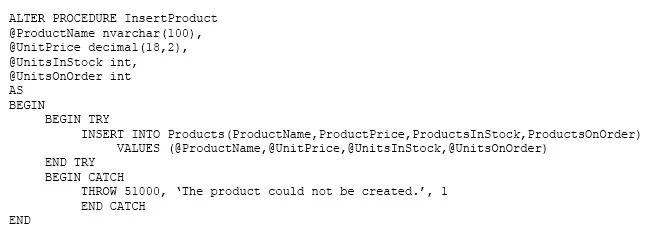
Solution: You run the following Transact-SQL statement:
Exam 70-761: Question 3 - Image 4
Does the solution meet the goal?
Answer

Suggested Answer

The suggested answer is B.

The solution provided does not explicitly handle transactions to ensure the operations are completed as a single unit of work. While TRY...CATCH blocks handle error reporting, they do not inherently provide transactional control. To ensure the product information is not permanently written to the database if an insert fails, you need to use explicit transaction handling with BEGIN TRANSACTION and ROLLBACK TRANSACTION in case of failure, along with COMMIT TRANSACTION upon successful completion. The absence of these transactional commands means the solution does not fully meet the described requirements.

Community Votes

No votes yet

Join the discussion to cast yours

Question 4 of 201

Note: This question is part of a series of questions that present the same scenario. Each question in the series contains a unique solution that might meet the stated goals. Some question sets might have more than one correct solution, while others might not have a correct solution.
After you answer a question in this section. You will NOT be able to return to it. As a result, these questions will not appear in the review screen.
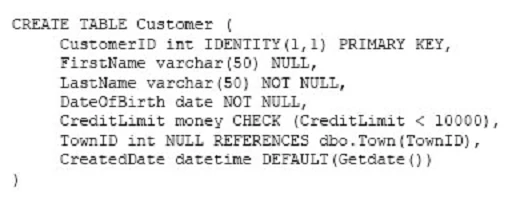
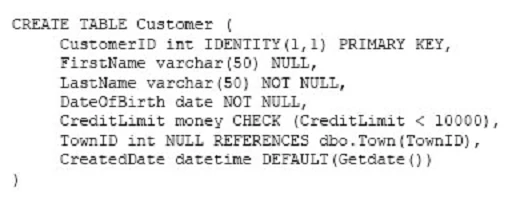
You create a table named Customer by running the following Transact-SQL statement:
Exam 70-761: Question 4 - Image 1
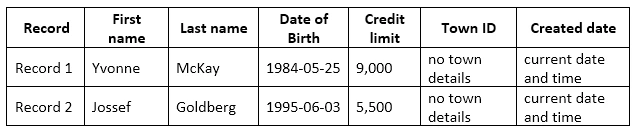
You must insert the following data into the Customer table:
Exam 70-761: Question 4 - Image 2
You need to ensure that both records are inserted or neither record is inserted.
Solution: You run the following Transact-SQL statement:
Exam 70-761: Question 4 - Image 3
Does the solution meet the goal?
Answer

Suggested Answer

The suggested answer is B.

The solution does not meet the goal because there are two separate INSERT statements. To ensure that both records are inserted or neither record is inserted, a transaction should be used. This can be achieved with BEGIN TRANSACTION, COMMIT, and ROLLBACK statements to group the inserts into a single transactional unit. Without a transaction, if an error occurs in the second INSERT statement, the first one could still be committed, which does not fulfill the requirement of 'both or neither'.

Community Votes

No votes yet

Join the discussion to cast yours

Question 5 of 201

Note: This question is part of a series of questions that present the same scenario. Each question in the series contains a unique solution that might meet the stated goals. Some question sets might have more than one correct solution, while others might not have a correct solution.
After you answer a question in this section. You will NOT be able to return to it. As a result, these questions will not appear in the review screen.
You create a table named Customer by running the following Transact-SQL statement:
Exam 70-761: Question 5 - Image 1
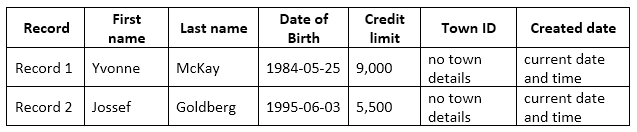
You must insert the following data into the Customer table:
Exam 70-761: Question 5 - Image 2
You need to ensure that both records are inserted or neither record is inserted.
Solution: You run the following Transact-SQL statement:
Exam 70-761: Question 5 - Image 3
Does the solution meet the goal?
Answer

Suggested Answer

The suggested answer is B.

The given solution will not ensure that both records are inserted or neither record is inserted. The solution consists of two separate INSERT INTO statements. If one of the statements fails, the other could still succeed, resulting in only one of the records being inserted. To ensure that both records are inserted or neither record is inserted, the statements must be executed within a single transaction using BEGIN TRANSACTION and COMMIT TRANSACTION. Additionally, you would need to set XACT_ABORT to ON to automatically roll back the transaction if any statement within the transaction fails. Therefore, the solution does not meet the goal.

Community Votes

No votes yet

Join the discussion to cast yours

About the Microsoft 70-761 Certification Exam

About the Exam

The Microsoft 70-761 (Querying Data with Transact-SQL) validates your knowledge and skills. Passing demonstrates proficiency and can boost your career prospects in the field.

How to Prepare

Work through all 201 practice questions across 41 pages. Focus on understanding the reasoning behind each answer rather than memorizing responses to be ready for any variation on the real exam.

Why Practice Exams?

Practice exams help you familiarize yourself with the question format, manage your time, and reduce anxiety on the test day. Our 70-761 questions are regularly updated to reflect the latest exam objectives.