Question 6 of 209
DRAG DROP -
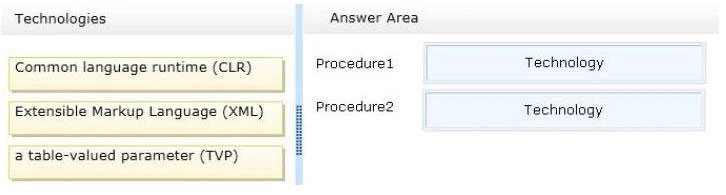
You are designing two stored procedures named Procedure1 and Procedure2.
You identify the following requirements:
✑ Procedure1 must take a parameter that ensures that multiple rows of data can pass into the stored procedure.
✑ Procedure2 must use business logic that resides in a Microsoft .NET Framework assembly.
You need to identify the appropriate technology for each stored procedure.
Which technologies should you identify?
To answer, drag the appropriate technology to the correct stored procedure in the answer area. (Answer choices may be used once, more than once, or not at all.)
Select and Place:
Exam 70-464: Question 6 - Image 1
Correct Answer:
References:
http://msdn.microsoft.com/en-us/library/ms131102.aspx
http://msdn.microsoft.com/en-us/library/bb522446.aspx
http://msdn.microsoft.com/en-us/library/bb510489.aspx Exam 70-464: Question 6 - Image 2
Question 7 of 209
You have an application that uses a view to access data from multiple tables.
You need to ensure that you can insert rows into the underlying tables by using the view.
What should you do?
Correct Answer: A

To ensure that you can insert rows into the underlying tables by using the view, you should create an INSTEAD OF trigger on the view. An INSTEAD OF trigger is executed instead of the data modification statement on which the trigger is defined (INSERT, UPDATE, or DELETE). This allows you to define the specific actions that must happen to process the data modification statement, effectively making the view updatable.

Question 8 of 209
You have a database that contains a user-defined function named Schema1.Udf1 and two tables named Schema1.Table1 and Schema1.Table2.
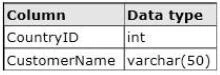
Schema1.Table1 has 1 million rows. The schema for Schema1.Table1 is configured as shown in the following table.
Exam 70-464: Question 8 - Image 1
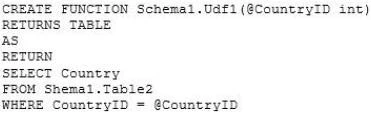
Schema1.Udf1 was defined by using the following code:
Exam 70-464: Question 8 - Image 2
You need to write a query that will contain the following columns:
✑ Country
✑ CountryID
✑ CustomerName
The solution must meet the following requirements:
✑ Rows must be returned only if the function returns data.
✑ The amount of time it takes the query to execute must be minimized.
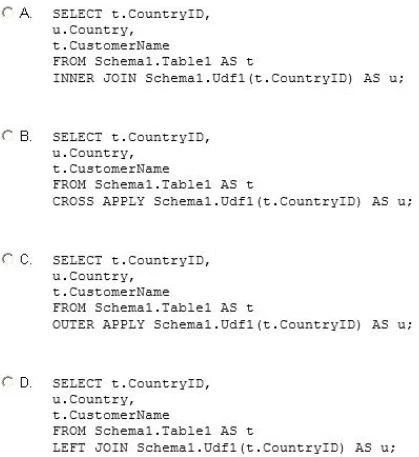
Which query should you use?
Exam 70-464: Question 8 - Image 3
Correct Answer: B

To meet the requirements of returning rows only if the function returns data and minimizing the execution time, the best choice is to use the CROSS APPLY operator. CROSS APPLY allows for applying the function to each row of the outer table (Schema1.Table1) and returns rows only when the function returns data. INNER JOIN would not be as appropriate here because it could result in a Cartesian product, and LEFT JOIN could return rows even when the function returns no data, which does not meet the requirements. Therefore, the correct query is the one that uses CROSS APPLY.

Question 9 of 209
You have a database hosted on SQL Azure.
You are developing a script to create a view that will be used to update the data in a table.
The following is the relevant portion of the script. (Line numbers are included for reference only.)
Exam 70-464: Question 9 - Image 1
You need to ensure that the view can update the data in the table, except for the data in Column1.
Which code segment should you add at line 06?
Correct Answer: A

To ensure that the view can update the data in the table except for the data in Column1, you should use 'WITH CHECK OPTION' in the view definition. This ensures that any updates or inserts through the view must meet the criteria specified in the WHERE clause. Therefore, the correct code segment to add at line 06 is 'WITH CHECK OPTION'.

Question 10 of 209
DRAG DROP -
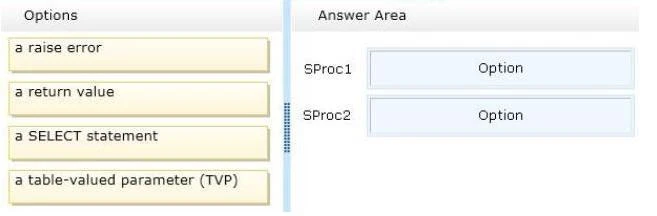
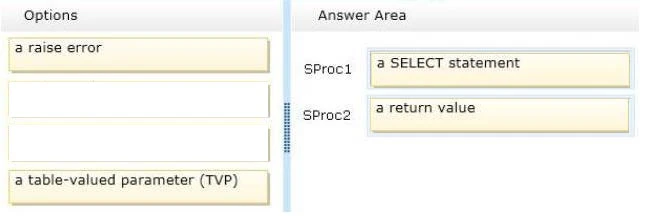
You are planning two stored procedures named SProc1 and SProc2. You identify the following requirements:
✑ SProc1 must return a table.
✑ SProc2 must return a status code.
You need to identify which options must be implemented to meet each stored procedure requirement.
Which options should you identify?
To answer, drag the appropriate option to the correct requirement in the answer area. (Answer choices may be used once, more than once, or not at all.)
Select and Place:
Exam 70-464: Question 10 - Image 1
Correct Answer:
Exam 70-464: Question 10 - Image 2