You have an Exchange Server 2013 organization that contains a server in each site. Each server has the Mailbox server role and the Client Access Server role installed.
All users connect to the Miami servers to retrieve the public folder hierarchy.
You need to create several public folders on the server in the Singapore office to meet the following requirements:
✑ Ensure that the public folders are available if a single Mailbox server fails.
✑ Ensure that the users in the Singapore office connect to their local server to retrieve the public folder hierarchy.
Which actions should you perform? (Each correct answer presents part of the solution. Choose all that apply.)
You have an Exchange Server 2013 organization that contains two servers. The servers are configured as shown in the following table.
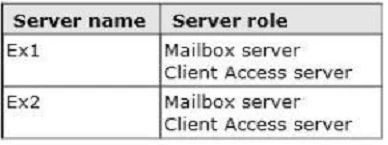
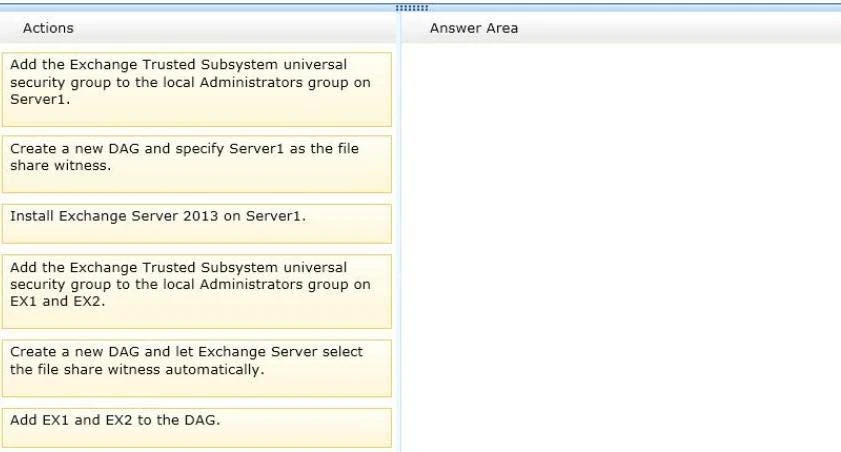
You need to create a new database availability group (DAG) that contains EX1 and EX2.
Which three actions should you perform?
To answer, move the three appropriate actions from the list of actions to the answer area and arrange them in the correct order.
Select and Place:
You deploy an additional Client Access server.
You also deploy an L4 hardware load balancer between the Client Access servers and the NAT device.
After deploying the hardware load balancer, you discover that all of the Exchange Server traffic is directed to a single Client Access server.
You need to ensure that the hardware load balancer distributes traffic evenly across both Client Access servers.
What should you do?
You need to recommend a solution to ensure that a user named User1 can access email messages by using Exchange ActiveSync on an Android device.
The solution must prevent all other users from using Android devices to access email by using Exchange ActiveSync.
What should you recommend doing first?
All users connect to their mailbox by using a mobile device.
All of the users in the finance department are in an organizational unit (OU) named OU1.
You need to prevent the finance users from accessing the extended storage on their mobile device.
What should you do?