[edit] [edit]
lab@r1# show protocols lab@r2# show protocols
ospf3 { ospf3 {
area 0.0.0.0 { area 0.0.0.0 {
interface 1o0.0; interface 1o0.0;
interface ge-1/0/6.0; interface ge-1/0/7.0;
}
}
lo0 = 172.16.100.1/32 [edit]
fc00:1000::1/128 lab@r2# show protocols
ospf3 {
area 0.0.0.0 {
interface 1o0.0;
interface ge-1/1/7.0;
interface ge-1/1/6.0;
}
}
You must ensure that r1's IPv4 loopback address exists in r3's inet 0 routing table.
Referring to the exhibit, which statement is true?
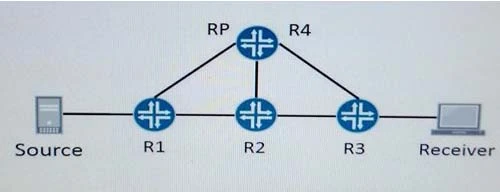
Referring to the exhibit, you have a network that uses PIM-SM and you need to block certain PIM register messages.
Which two statements are correct in this situation? (Choose two.)
Which MPLS traffic engineering parameter would accomplish this task?
user@router# run show route 2.0.0.0/8
inet.0: 101 destinations, 198 routes (100
active, 0 holddown, 1 hidden)
+ = Active Route, - = Last Active, * = Both
2.0.0.0/8 *[BGP/170] 00: 12:06, MED
1000, Localpref 100, from 10.220.1.2
As path: 2000 I,
validation-state: unverified
> to 10.220.15.2 via ge-
1/0/0.0, label-switched-path r1-to-r3
to 10.220.12.2 via ge-
1/1/0.0, label-switched-path r1-to-r3
[BGP/170] 00 10, MED
1000, localpref 100, from 10.220.1.5
AS path: 2000 I,
validation-state: unverified
> to 10.220.15.2 via ge-
1/0/0.0, label-switched-path r1-to-r3
to 10.220.12.2 via ge-
1/1/0.0, label-switched-path r1-to-r3
2.6.6.6/32 *[BGP/170] 00:12:06, MED
1000, localpref 100, from 10.220.1.2
AS path: 2000 I,
validation-state: unverified
> to 10.220.15.2 via ge-
1/0/0.0, label-switched-path r1-tor3
to 10.220.12.2 via ge-
1/1/0.0, label-switched-path r1-to-r3
[BGP/170] 00:12:10, MED
1000, localpref 100, from 10.220.1.5
AS path: 2000 I,
validation-state: unverified
> to 10.220.15.2 via ge-
1/0/0.0, label-switched-path r1-to-r3
to 10.220.12.2 via ge-
1/1/0.0, label-switched-path r1-to-r3
user@router# run show route advertising-protocol
bgp 192.168.11.0
inet.0: 101 destinations, 198 routes (100
active, 0 holddown, 1 hidden)
Prefix Nexthop
MED Lclpref AS path
* 2.6.6.6/32 Self
2000 I
[edit protocols bgp]
user@router# show
export reject;
group peer {
export as1000;
neighbor 192.168.11.0 {
family inet {
unicast;
}
peer-as 1000;
}
}
[edit policy-options]
user@router# show
policy-statement as1000 {
term 1 {
from {
route-filter 2.0.0.0/8 longer;
}
then accept;
}
term 2 {
then reject;
}
}
policy-statement reject {
term 1 {
from {
route-filter 2.0.0.0/8 exact;
}
then reject
}
}
You want to advertise routes 2.0.0.0/8 and 2.6.6.6/32 to BGP peer 192.168.11.0.
Referring to the exhibit, which configuration change would satisfy this requirement?