To configure an interface on an MX Series device to receive and forward both single-tag and dual-tag frames, you need to use the 'flexible-vlan-tagging' option. This option allows for the flexibility needed to handle multiple VLAN tagging types on the same interface.

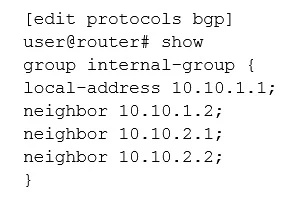
In the given configuration for an IBGP group, the commit fails because the type of the group has not been specified. In BGP, a group must be categorized either as 'internal' or 'external' to define the relationship with peers. Since this is an IBGP group, the correct parameter to add is 'type internal'. This informs the router that the neighbors within this group are part of the same Autonomous System (AS). Specifying 'type internal' will resolve the configuration issue by allowing the router to use its own AS number for all the peers in the group.


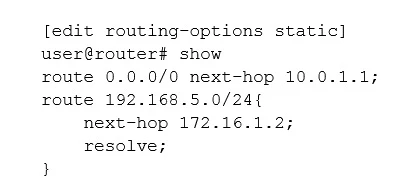
The next-hop 172.16.1.2 must be part of an active route in route table inet.0 for route 192.168.5.0/24 to be active. This is because the resolve statement instructs the router to look up the next-hop address in the routing table (inet.0) to find a corresponding active route. If the next-hop 172.16.1.2 has an active route in inet.0, the router will use that route to forward packets to the 192.168.5.0/24 destination.
IBGP speakers advertise EBGP-learned routes to other IBGP peers and EBGP speakers advertise IBGP-learned routes to other EBGP peers. This is because, by default, IBGP does not propagate routes within its own peers unless a policy is specifically configured to do so. Therefore, option A is incorrect because IBGP speakers do not advertise IBGP-learned routes to other IBGP peers. Option B suggests using a policy to advertise IBGP-learned routes to EBGP peers, but by default, EBGP speakers can advertise routes learned from IBGP peers to other EBGP peers without an explicit policy, making option D correct.