The company is planning to launch a new application for smartphones and tablets that will allow customers to view their energy readings remotely and also view their daily budget usage based on seasonal historic data. The application must support customers with disabilities.
The application is being delivered using a hybrid mix of agile and V-model methodologies over three iterations:
Iteration 1 - Development of the new application to work on the IOS operating system only.
Iteration 2 - Enhancement to the application to also work on the Android operating system.
Iteration 3 - Enhancement to the application to provide daily budget usage.
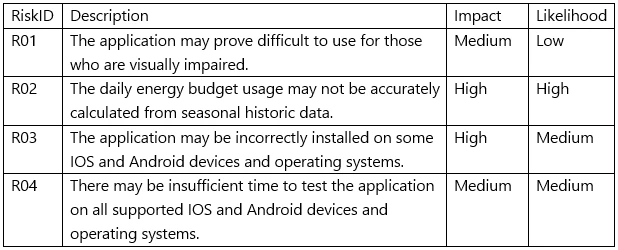
As the test analyst, you have been asked to review the risk register and design test conditions for the highest priority product risks that fall into your area of responsibility, relating to Iterations 1 and 2 only. Which of the following product risks would you design test conditions for first?
Time to Complete Game - Maximum 180 seconds. If the input value exceeds this amount, then the component outputs error message TIME1
Points Earned - minimum 5 to a maximum of 25. If the input value is outside this range the component outputs error message EM1
Level of Difficulty - from 1 to a maximum of 4. If the input value is outside this range the component outputs error message EM2
Assuming there are no error messages, a total score is then calculated by the component as (Points Earned * Level of Difficulty)
The trophy levels are:
Blue - total score equal to or less than 40
Silver - total score > 40 -
Gold - total score > 70 -
Diamond - total score > 80 -
Platinum - total score > 90 -
The component then outputs the correct trophy level
Applying the Equivalence Partition test design technique to this component and assuming that each error message and each trophy level represents a separate output partition, what percentage of the total output partitions have been exercised by the following suite of test cases?
Player 1 - Points earned 25, level of difficulty 2, time 60 seconds.
Player 2 - Points earned 20, level of difficulty 3, time 120 seconds.
Player 3 - Points earned 30, level of difficulty 1, time 200 seconds.
Items sold for £150 or less attract a flat-rate fee of £7.00, items otherwise sold for less than £500 have a fee of 6% of the price realised. Items otherwise sold for less than £1000 have a 4.5% fee, with items otherwise sold for less than £5000 having a 3.5% fee. Any items sold for £5000 or more have a 3% fee.
Following customer feedback, Sell-It-Cheap have decided to change one of the existing commission bandings, with items sold between £500 and £749 having a 5.5% fee, and items otherwise less than £1,000 having a 4.5% fee.
What tests would be appropriate to test this change in commission bandings, using the 2-point boundary value analysis technique?
Insurance is offered and the premium is calculated according to the following rules:
Insurance cover is NOT given to those aged 70 or more, or below 18.
Those who consume on average more than 14 units of alcohol a week have an additional premium of £25 per month.
Those with a BMI greater than 35 are NOT given insurance cover.
Smokers have an additional premium of £20 per month.
Those in full-time employment have a premium reduction of £20 per month.
How many test cases are required to give full coverage for the above rules when using a decision table that excludes rules containing infeasible combinations of condition values?