Question 6 of 173
Refer to the exhibit.
Exam HPE6-A45: Question 6 - Image 1
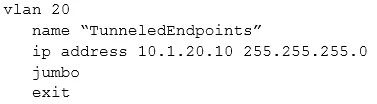
A network administrator needs to deploy AOS-Switches that implement port-based tunneled node. Their Aruba controller has IP address 10.1.10.5/24. The architect has assigned tunneled-node endpoints to VLAN 20.
What is one issue with the current configuration planned for VLAN 20 on the switch?
Correct Answer: B

For port-based tunneled node configurations, VLANs assigned to support tunneled-node endpoints typically do not have an IP address configured. This is because the VLAN is used to handle traffic that is tunneled to an Aruba controller, which means the IP addressing is managed by the controller, not the switch itself. Hence, VLAN 20 should not have an IP address.

Question 7 of 173
OSPF Area 1 has two ABRs. One ABR is configured with this range for Area 1: 10.10.0.0/16. The other ABR is not configured with a range for Area 1.
Which type of issue occurs due to this mismatch?
Correct Answer: D

When there is a range mismatch between two ABRs in OSPF, they can lose adjacency within the area where the mismatch occurs. As a result, the ABRs must route all traffic to each other through the backbone area, which is Area 0 in OSPF. This situation does not create a discontinuous area or disrupted intra-area routing but rather forces traffic to follow a less efficient path, impacting overall routing efficiency.

Question 8 of 173
Refer to the exhibits.
Exhibit 1.
Exam HPE6-A45: Question 8 - Image 1
Exhibit 2.
Exam HPE6-A45: Question 8 - Image 2
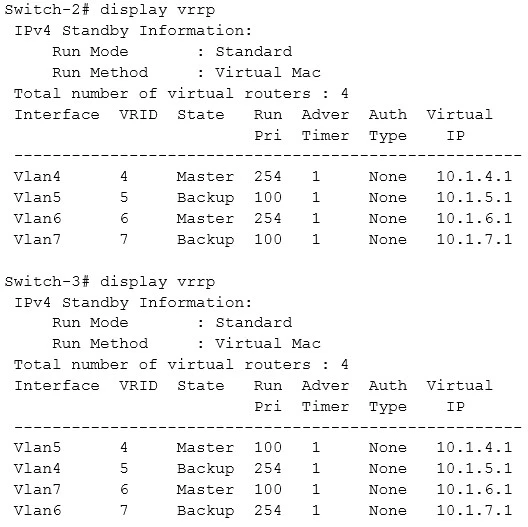
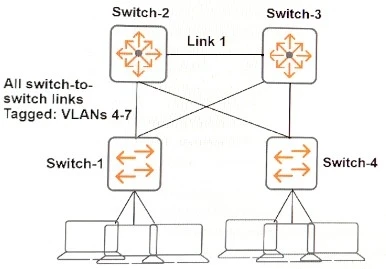
The company wants to minimize congestion on Link 1.
Which spanning tree implementation meets this goal?
Correct Answer: B

To minimize congestion on Link 1, switch-to-switch traffic should be evenly distributed across the switches. By assigning Switch 2 as the root for VLANs 4 and 6, and Switch 3 as the root for VLANs 5 and 7 (as detailed in Option B), traffic will be better balanced. This ensures that no single link is disproportionately utilized, thereby minimizing congestion on Link 1.

Question 9 of 173
Refer to the exhibit.
Exam HPE6-A45: Question 9 - Image 1
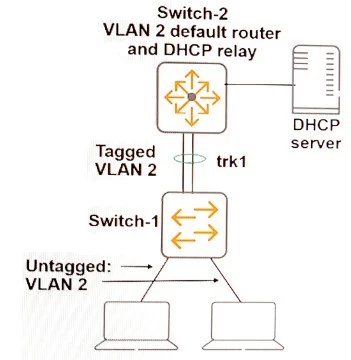
The network administrator enables DHCP snooping globally and on VLAN 2. An additional step is mandatory for DHCP snooping to operate correctly and for clients to receive DHCP settings.
What is the additional mandatory step?
Correct Answer: A

To ensure DHCP snooping operates correctly and clients receive the appropriate DHCP settings, you need to define the trunk port (trk1) as a trusted DHCP port. By default, all ports, including trunk ports, are considered untrusted, which means DHCP offers and acknowledgments cannot pass through them. Defining the trunk port as trusted allows the legitimate DHCP traffic to be forwarded to the clients.

Question 10 of 173
Refer to the exhibit.
action. Device 1 crosses the threshold and triggers the action.
What does the switch do?
Correct Answer: A

When Device 1 crosses the threshold and triggers the action, the switch temporarily drops all IP traffic from Device 1 only. This is in line with how connection rate filtering typically functions, where the specific offending device is targeted rather than an entire interface.