Question 6 of 86
An administrator has decreased all the TCP session timers to optimize the FortiGate memory usage. However, after the changes, one network application started to have problems. During the troubleshooting, the administrator noticed that the FortiGate deletes the sessions after the clients send the SYN packets, and before the arrival of the SYN/ACKs. When the SYN/ACK packets arrive to the FortiGate, the unit has already deleted the respective sessions. Which TCP session timer must be increased to fix this problem?
Correct Answer: A
The issue described involves the FortiGate deleting sessions after clients send SYN packets but before receiving the SYN/ACK packets. This indicates a problem with how long half-open TCP sessions (sessions where the handshake is not yet complete) are kept alive. To fix this, increasing the TCP half open session timer would allow more time for the SYN/ACK packets to arrive and complete the handshake before the session is terminated.
Question 7 of 86
An administrator is running the following sniffer in a FortiGate: diagnose sniffer packet any "host 10.0.2.10" 2
What information is included in the output of the sniffer? (Choose two.)
What information is included in the output of the sniffer? (Choose two.)
Correct Answer: B, C
When running the command 'diagnose sniffer packet any "host 10.0.2.10" 2' on a FortiGate, the sniffer captures packets with a verbosity level of 2. At this level, the output includes the IP headers and the IP payload of the packets. Specifically, verbosity level 2 includes header information up to the IP layer and the actual data being transmitted in the IP payload. Ethernet headers are included in verbosity level 3 and above, while port names are not included in this output.
Question 8 of 86
Examine the partial output from two web filter debug commands; then answer the question below:
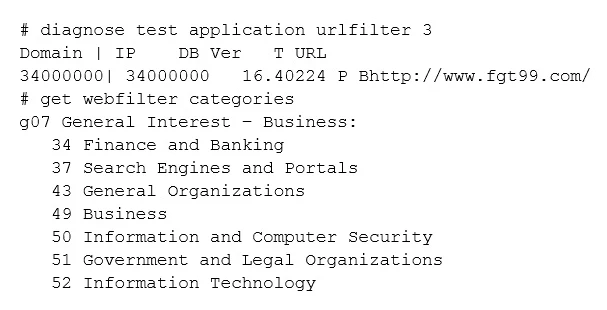
Based on the above outputs, which is the FortiGuard web filter category for the web site www.fgt99.com?
Based on the above outputs, which is the FortiGuard web filter category for the web site www.fgt99.com?
Correct Answer: D
The FortiGuard web filter category for the website www.fgt99.com is 52, corresponding to Information Technology. The hex value 34000000 converts to decimal 52.
Question 9 of 86
Examine the output of the "˜get router info ospf interface' command shown in the exhibit; then answer the question below.
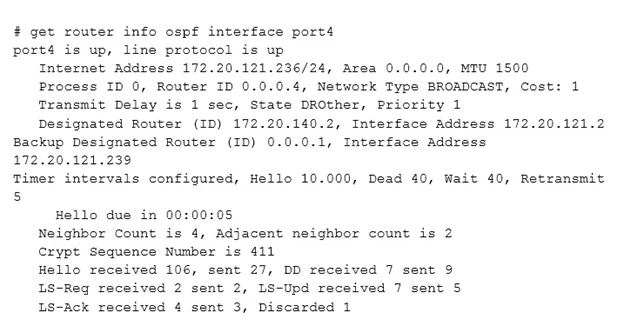
Which statements are true regarding the above output? (Choose two.)
Which statements are true regarding the above output? (Choose two.)
Correct Answer: A, C
The port4 interface is in OSPF backbone area, this is verified by the area ID 0.0.0.0 mentioned. Additionally, the neighbor count being 4 along with an adjacency count of 2 indicates that there are at least five OSPF routers in the port4 network: the local router and its four neighbors.
Question 10 of 86
Examine the output of the "˜get router info bgp summary' command shown in the exhibit; then answer the question below.
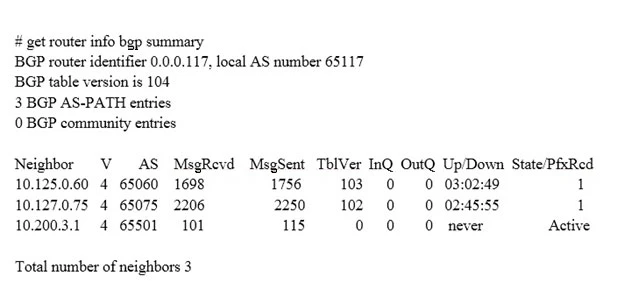
Which statements are true regarding the output in the exhibit? (Choose two.)
Which statements are true regarding the output in the exhibit? (Choose two.)
Correct Answer: A, C
The BGP state of the peer 10.125.0.60 is Established, as indicated by the Up/Down time of 03:02:49 and a prefix received count of 1. This confirms that the BGP session is successfully established with this peer. On the other hand, the BGP peer 10.200.3.1 is in the 'Active' state, which means it has not established a TCP connection. This also implies that the local BGP peer has not received an OpenConfirm from 10.200.3.1.