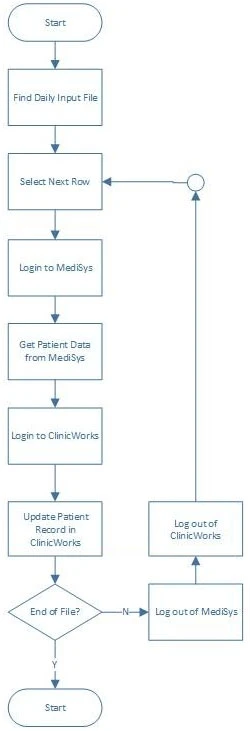
Question 6 of 27Consider the following high-level design. The solution is intended to read medical data from one application in order to update another. An input file is prepared by an overnight batch run for the solution to work through each morning before patients arrive. Usually the input file is fairly small but at certain times each month the file is much larger. Which of these options should be considered be the process solution designer to guarantee the quality of the end-to-end solution? (Choose four.)
Correct Answer: B, E, G, H
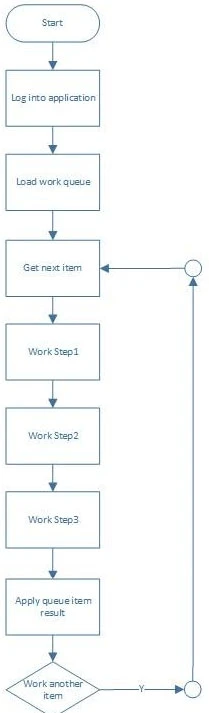
Question 7 of 27Consider the following high-level design. The application concerned is prone to being sluggish or even unresponsive at times. As the solution designer you should anticipate that there will be system exceptions and that after an exception case the application might not be in an ideal state. What should you do? (Choose three.)
Correct Answer: A, B, C
Question 8 of 27Consider the following steps for a theoretical manual process. ✑ Check in input folder any new files. ✑ If there are no files check again later as files can arrive anytime, and there is no limit to the number of files that may come. ✑ Open the next available file. ✑ Take the first case. ✑ Start System X and find the case details. ✑ If the case can't be found, move to the next one. ✑ After finding the case in System X, fetch additional case details from System Y. ✑ Again if the case can't be found, move to the next one. ✑ Analyse all the data to see if System Z should be updated. ✑ If the data does not meet the requirements, add notes indicating this to System X and Y and move to the next case. ✑ If the data does meet the requirements, update the case in System Z. ✑ Add notes to System X and Y and move to the next case. ✑ At the end of the file, go back and look for another. ✑ Stop checking for new files at 16:00 and finish any remaining cases. ✑ When all work is complete create a report of the day's exception cases. Close down Systems X, Y and Z. If the volume of incoming cases is such that 1 Resource PC can easily handle the workload, which of the following steps for an automated solution should be part of the "˜Preparation' phase of an automated process?
Correct Answer: C
Question 9 of 27Consider the following steps for a theoretical manual process. ✑ Check in input folder any new files. ✑ If there are no files check again later as files can arrive anytime, and there is no limit to the number of files that may come. ✑ Open the next available file. ✑ Take the first case. ✑ Start System X and find the case details. ✑ If the case can't be found, move to the next one. ✑ After finding the case in System X, fetch additional case details from System Y. ✑ Again if the case can't be found, move to the next one. ✑ Analyse all the data to see if System Z should be updated. ✑ If the data does not meet the requirements, add notes indicating this to System X and Y and move to the next case. ✑ If the data does meet the requirements, update the case in System Z. ✑ Add notes to System X and Y and move to the next case. ✑ At the end of the file, go back and look for another. ✑ Stop checking for new files at 16:00 and finish any remaining cases. ✑ When all work is complete create a report of the day's exception cases. ✑ Close down Systems X, Y and Z. If it is possible that there are long intervals between files arriving, what are the alternatives the process should take to control System X, System Y and System Z? (Choose two.)
Correct Answer: B, E
Question 10 of 27Consider the following steps for a theoretical manual process. ✑ Check in input folder any new files. ✑ If there are no files check again later as files can arrive anytime, and there is no limit to the number of files that may come. ✑ Open the next available file. ✑ Take the first case. ✑ Start System X and find the case details. ✑ If the case can't be found, move to the next one. ✑ After finding the case in System X, fetch additional case details from System Y. ✑ Again if the case can't be found, move to the next one. ✑ Analyse all the data to see if System Z should be updated. ✑ If the data does not meet the requirements, add notes indicating this to System X and Y and move to the next case. ✑ If the data does meet the requirements, update the case in System Z. ✑ Add notes to System X and Y and move to the next case. ✑ At the end of the file, go back and look for another. ✑ Stop checking for new files at 16:00 and finish any remaining cases. ✑ When all work is complete create a report of the day's exception cases. ✑ Close down Systems X, Y and Z. It is imperative that notes are applied to System X and Y, regardless of whether System Z is updated or not, what could the process do? (Choose two.)